Seat finder
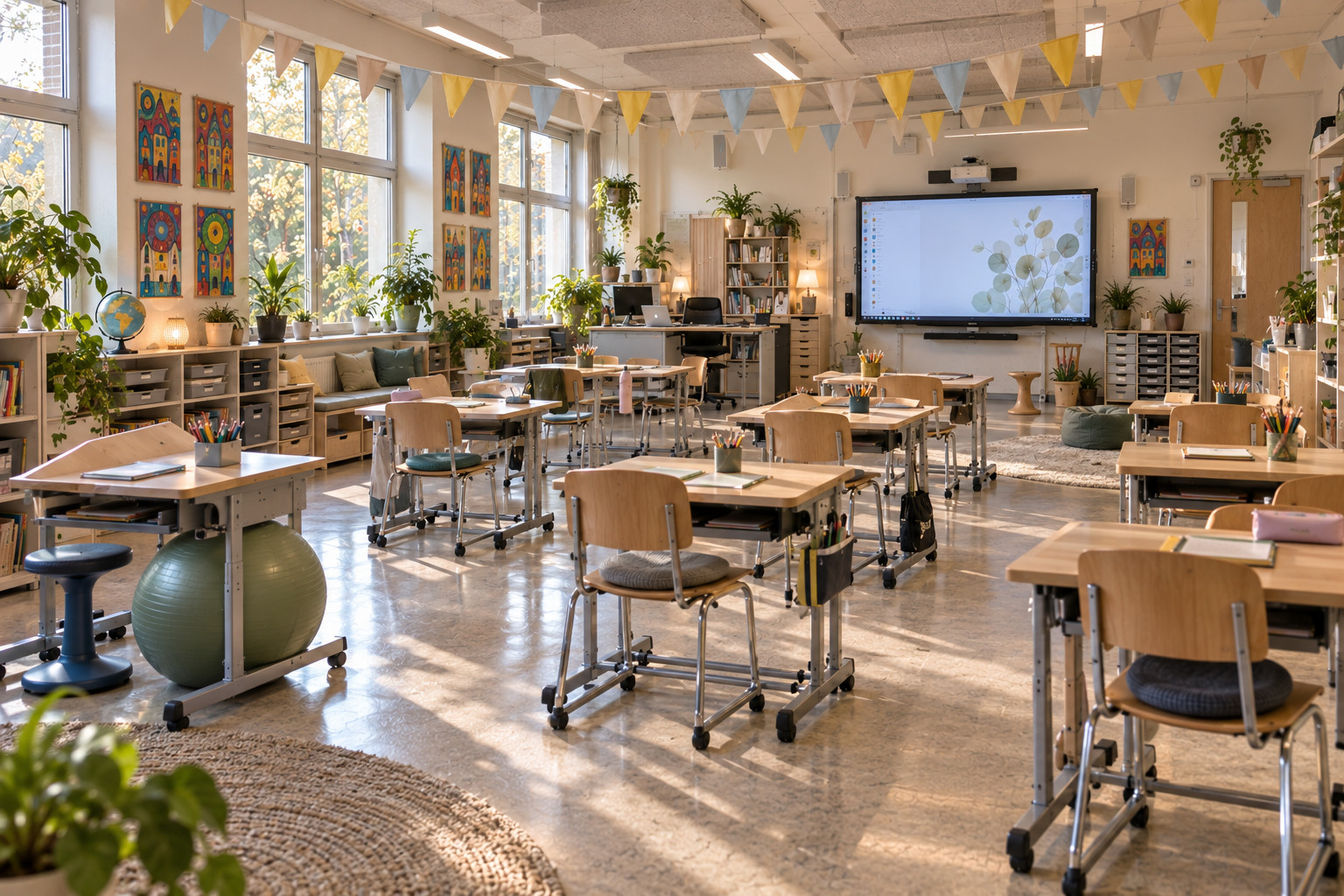
Seating is selected according to the child, the teaching situation and the support needed at that moment. The aim is to provide a workspace that supports attention, participation, movement and independent learning as effectively as possible.
Key Information
School Level(s): Cycles 1 and 2
Curriculum Link: Cross-curricular competencies
Implementation
Basic principle. There is no single correct seat for every situation. The choice depends on the child’s needs and on the conditions that help them stay attentive, participate and work as independently as possible in that particular learning phase.
Do not automatically seat the child at the front. A seat near the teacher can help when a child often loses track of instructions, drifts off mentally or benefits from brief eye contact and discreet prompts. For a child who is easily distracted, a quieter seat with fewer visual or social stimuli may be more suitable.
For daydreaming. A highly secluded seat is not automatically helpful. A clear view of the teacher, board and classroom activity can help the child reconnect with the lesson. Agreed discreet cues can provide additional support.
For high distractibility. Look deliberately at the child’s visual field and surroundings: doors, walkways, material stations or very talkative peers. Sometimes a small change in position or neighbouring pupils is enough.
For a strong need for movement. An edge seat or a place with a little more space can make position changes easier without repeatedly interrupting other pupils’ work.
Whole-class teaching at desks. During whole-class instruction, a clear view of the teacher, board and demonstrations, as well as opportunities for brief contact, can be important. A seat closer to the front may be suitable, but this is not always necessary. Depending on the child, a seat to the side, some distance from busy walkways or a place next to a calm classmate may be more appropriate.
Circle time and whole-class discussions. Seating should also be chosen thoughtfully during circle time. For children who tend to daydream or lose track of the discussion, a seat with a clear view of the teacher and the centre of the circle can be helpful. Sitting directly next to the teacher can make brief, discreet prompts easier. For children who are easily distracted, it may be helpful to avoid seating them next to particularly restless or talkative classmates or close to busy areas of the classroom. Children with a strong need for movement may benefit from a place at the edge of the circle, where small changes in position are possible without repeatedly disrupting the group. Here too, the most suitable place depends on the child, the group and the purpose of the particular discussion.
Open learning and individual work. During workshops, learning plans or individual work, other criteria may matter more: fewer distractions, sufficient workspace, a quiet area or the option to move temporarily to another place.
Partner and group work. The composition of the group becomes as important as the location. A suitable learning partner or calm group may make more difference than where the table is positioned.
Consider the teacher’s position. Proximity to the teacher does not automatically mean sitting at the front. When the teacher moves around, sits with groups or works temporarily from the back of the room, proximity changes. The teacher’s own position can therefore be varied deliberately.
Allow flexible seating. A child does not necessarily have one optimal seat for the entire day. Depending on the learning phase, a place for whole-class input, a quiet individual workspace or a group table may be appropriate.
Involve the child. Discuss where listening and working go well, what is distracting and what helps the child return to the task. Combine the child’s view with the teacher’s observations.
Try, observe and adjust. Test a change for an agreed period. For example, observe whether the child starts more easily, stays engaged longer, needs fewer reminders or regulates movement more successfully. Keep or adjust the seat accordingly.
Important: professional judgement. These points are not fixed seating rules. The teacher assesses the specific situation, teaching format, classroom dynamics and the child’s current needs. What helps today or during quiet work may be unsuitable tomorrow or during group work.
Avoid punishment seats. An individual seat, edge seat or place near the teacher should be used as support rather than as a sanction. The aim is a suitable learning environment without visibly singling out the child.
Material
No additional materials are required. Different workspaces in the classroom can be used depending on the learning phase.
References
After: Selin Güler, primary school teacher and Translation Manager at BeLEARN