Pen Race Quick Implementation
Using a pen, players navigate more than 90 varied racetracks: tracing paths, avoiding obstacles and collecting coins. Driving rules and three track widths allow the level of difficulty to be adjusted flexibly, while also training graphomotor skills, attention, impulse control and working memory.
Key Information
Subject/Area: Executive Functions / Graphomotor Skills
School Level(s): Cycles 1 and 2
Curriculum Alignment:
Interdisciplinary skills, personal skills. Pupils can find their way in new and unfamiliar situations, take on challenges and deal with them constructively, and concentrate on a task while working on it with perseverance and discipline.
Implementation
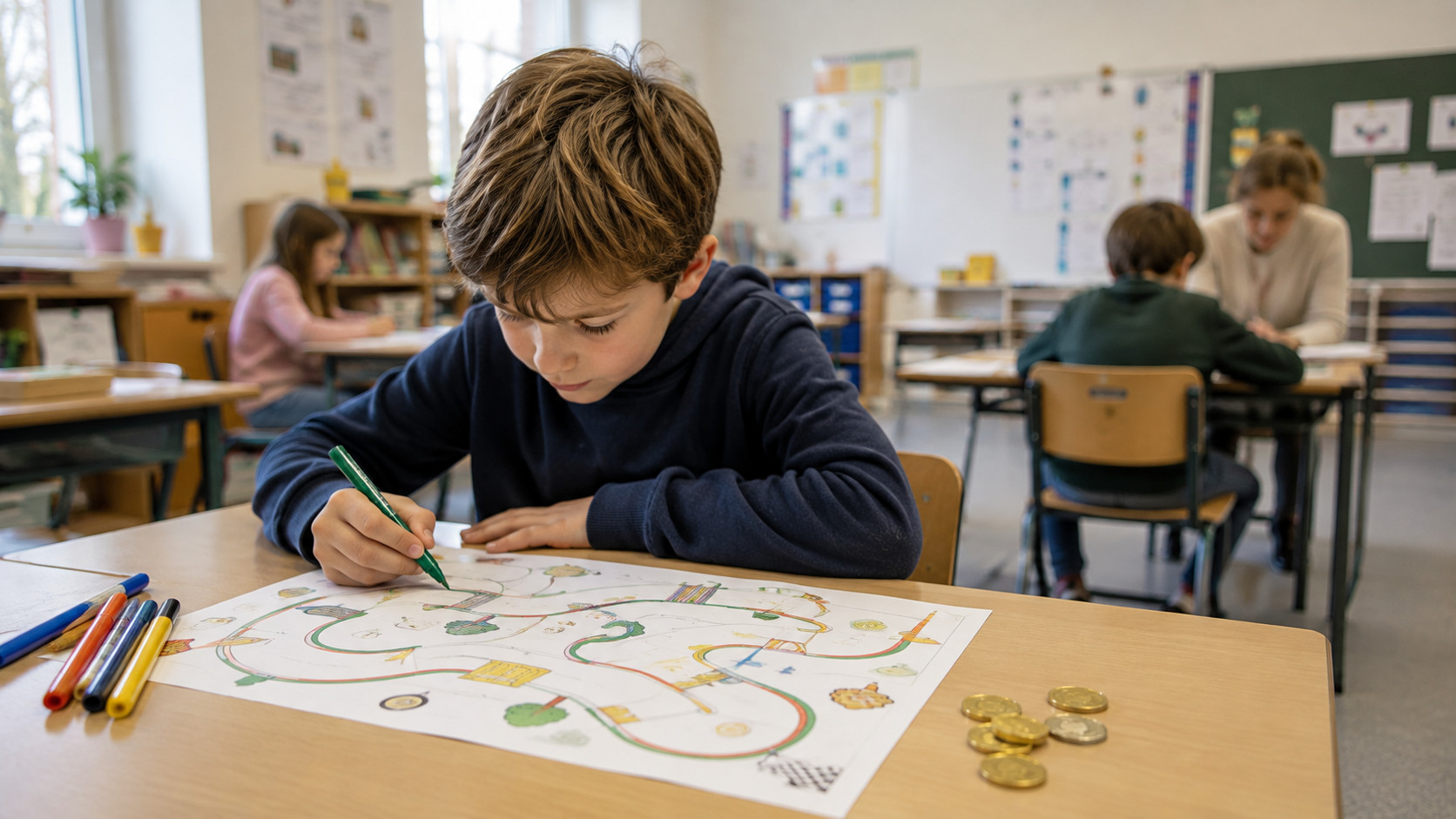
“Pen Race” by Kerstin Diehl is an activity book that playfully promotes graphomotor skills and executive functions. It contains more than 90 illustrated racetracks for children to trace with a pen. They become racing drivers themselves and must stay within the lanes, avoid or jump over obstacles, collect real coins along the way and leave the fake ones behind.
Each of these elements has a simple driving rule indicated by a symbol on the track. The racetracks are available in three lane widths. The rules are introduced individually and later combined into more challenging tasks, allowing the level of difficulty to be increased gradually and adapted to each child.
In this way, attention, cognitive flexibility, impulse control and working memory are trained almost incidentally, without the activity feeling like an exercise to the children. Each practice session takes only a few minutes and can be incorporated flexibly into lessons.
The principle is easy to explain: each symbol along the track represents a driving rule—for example, avoiding or jumping over an obstacle, collecting a coin or leaving a fake coin behind. It is best to start with wide lanes and just a few rules, then gradually introduce additional ones. A consistent routine gives children confidence and helps them become more independent.
Before the first run, it is helpful to look at the track together, name the rules and trace the route with a finger first. This allows children to become familiar with the course and its obstacles and to plan their approach in advance. Once a child has started an exercise, they should not be interrupted, even if they make mistakes. Self-assessment comes afterwards: using the rule symbols, the child can review their own run with questions such as, “What was the rule for this symbol again? Does that match what you did?”
If children experience difficulties, additional picture cards and saying the actions aloud can help. Using different writing tools—such as coloured pencils, felt-tip pens or Neocolor crayons—changes the pressure and grip required and keeps the exercise varied. Using a whiteboard marker on a laminated sheet or completing the activity on a tablet can reduce stress, as mistakes are easy to correct. Depending on the child’s level of understanding, the exercises do not need to be completed in full.
To increase the level of difficulty, the lanes can be narrowed, several driving rules can be combined or a timer can be used as an additional incentive. Children can also use the blank templates provided in the book to design their own tracks. This ensures that the material remains engaging over time and can be adapted to each child’s individual level.
Materials
-
- Pen Race book by Kerstin Dehl
- Various writing and drawing tools (coloured pencils, felt-tip pens, Neocolor crayons, etc.)
References
Based on: Regina Beyeler, special education teacher, Bitzius Primary School, Bern
Source: Diehl, Kerstin (2023): Stiftrennen: Achtung: Exekutive Funktionen am Steuer. Dortmund: verlag modernes lernen.