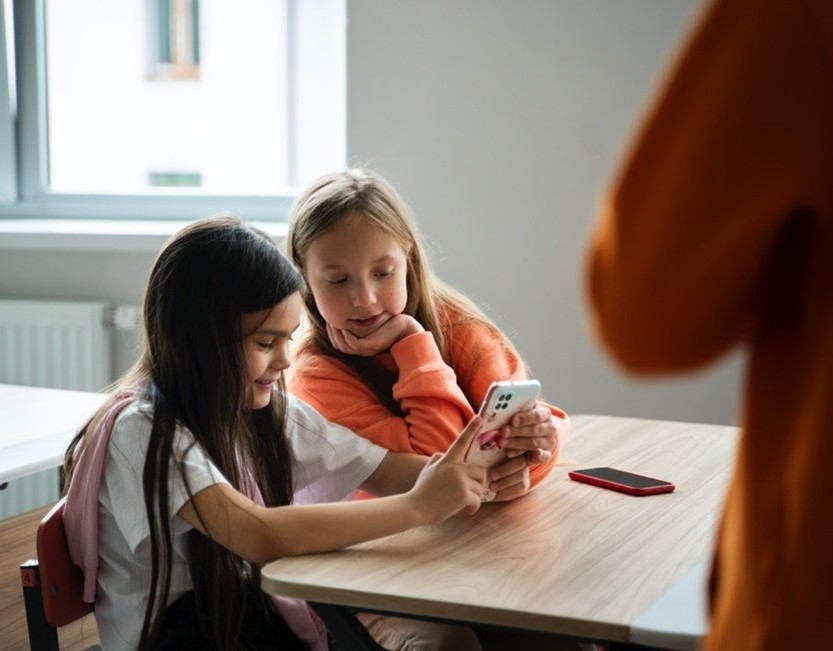
Co-Smart: Development of School Policies on Smartphone and Smartwatch Use
Together with schools, children and parents, the project develops practical smartphone and smartwatch regulations for Swiss primary schools.
Duration: 1 January 2027 – 31 December 2027
Status: Planned
Educational Level: Primary Level
Topic: Digital Ethics, Digital Skills, Digital Tools
Keywords: Smartphone and smartwatch regulations; rules and agreements; primary schools; intervention study; mixed methods
Initial Situation
Smartphone use is widespread among children: almost half of children aged 6–13 own a smartphone (Feierabend et al., 2024). Schools face the challenge of regulating smartphone use during the school day, with approaches ranging from comprehensive bans on smartphones and smartwatches to their purposeful integration into classroom instruction. Parental perspectives also vary: some regard reduced opportunities to contact their children as a safety concern, whereas others support restrictions to reduce distraction, excessive use, and cyberbullying.
Despite broad public support for school-based smartphone and smartwatch regulations, empirical evidence regarding their effectiveness remains mixed. Some studies report no significant effects on device use or psychological well-being (Goodyear et al., 2025), while others identify positive effects on well-being, social behaviour, and academic achievement (Böttger & Zierer, 2024; Beland & Murphy, 2015). These findings highlight the need to investigate how school-based regulations can be effectively designed and implemented.
The project builds on PhocusPrim, a BeLEARN Booster project examining smartphone and smartwatch regulations in primary schools in the Canton of Bern from the perspectives of children, teachers, school principals, and parents. A systematic synthesis of these findings will provide the foundation for the participatory development of intervention measures within the present study.
Objectives
The project aims to co-develop school-based smartphone and smartwatch regulations for primary schools in collaboration with children, teachers, school principals, and parents. It focuses on the conceptualisation, feasibility, acceptability, and appropriateness of different measures, as well as factors that facilitate or hinder their implementation. The collaborative conceptualisation of the intervention will provide the foundation for practice-oriented recommendations and a scientifically grounded follow-up study examining the effectiveness of smartphone and smartwatch regulations.
Method
The project employs a participatory mixed-methods design to co-develop smartphone and smartwatch regulations for primary schools (Cycle 2). First, survey data and semi-structured interviews from the BeLEARN Booster project PhocusPrim will be systematically analysed and integrated to identify stakeholders’ needs, experiences, and perspectives. Subsequently, children, teachers, parents, and school principals from the participating schools will collaboratively develop and refine intervention measures through workshops. This iterative process will address acceptability, appropriateness, and practical implementation. The measures and their planned implementation will be jointly operationalised and systematically documented.
Planned Translation
The project integrates research and educational practice from the outset: children, teachers, school principals, and parents will collaboratively develop and critically reflect on practical smartphone and smartwatch regulations for primary schools (Cycle 2). Participatory workshops will generate evidence-informed recommendations, concrete implementation models, and minimum standards that schools can adapt to their local contexts. The findings will be disseminated and further developed through BeLEARN Connect, events, network meetings, scientific publications, and conference contributions.
The project provides primary schools with evidence-based, context-sensitive approaches to smartphone and smartwatch regulation. Involving children, teachers, school principals, and parents helps ensure that the measures address their needs and are feasible in everyday school practice. For research, the project establishes a foundation for a subsequent effectiveness study examining primary school students’ well-being, learning, and academic achievement. The project’s impact will be assessed through stakeholder feedback on the feasibility, acceptability, and appropriateness of the co-developed measures. Practice-oriented guidelines and implementation models will support their transfer to other schools.