Digitalisation in Healthcare
Nurses training: VR tool for fostering digital competencies tested along with analysis of observations gathered from hospitals during an ethnographic study.
Duration: January 2024- December 2024
Status: Completed
Educational Level: Tertiary Level
Topic: Digital Skills & Literacy
Keywords: Digital Skills, VR
Initial Situation
In the project “Digitalisation and transmission of clinical information in nursing: implications and perspectives (Digi-Care)”, which was a part of national research programme 77 “Digital Transformation”, the SFUVET and the Institute for Medical Informatics at the Bern University of Applied Sciences (BFH) developed a virtual reality (VR) prototype and text-based learning situations that could be used for the initial and continuous training of nurses, and suggestions for optimized workflows in digital systems. The prototypes and learning situations were based on an ethnographic study in hospitals, in which nurses were accompanied and filmed during their daily work. The participating nurses were then invited to comment on video footage (showed to them) to get ahold of the nurses’ own perception of their performed activities.
Follow-up Project
In the follow-up project VR in Nursing and Medical Informatics Education, the VR prototype is implemented in two different areas—nursing and medical informatics—while examining existing barriers and requirements for the use of immersive VR tools in tertiary education and evaluating the effectiveness of the VR-based teaching units.
Objectives
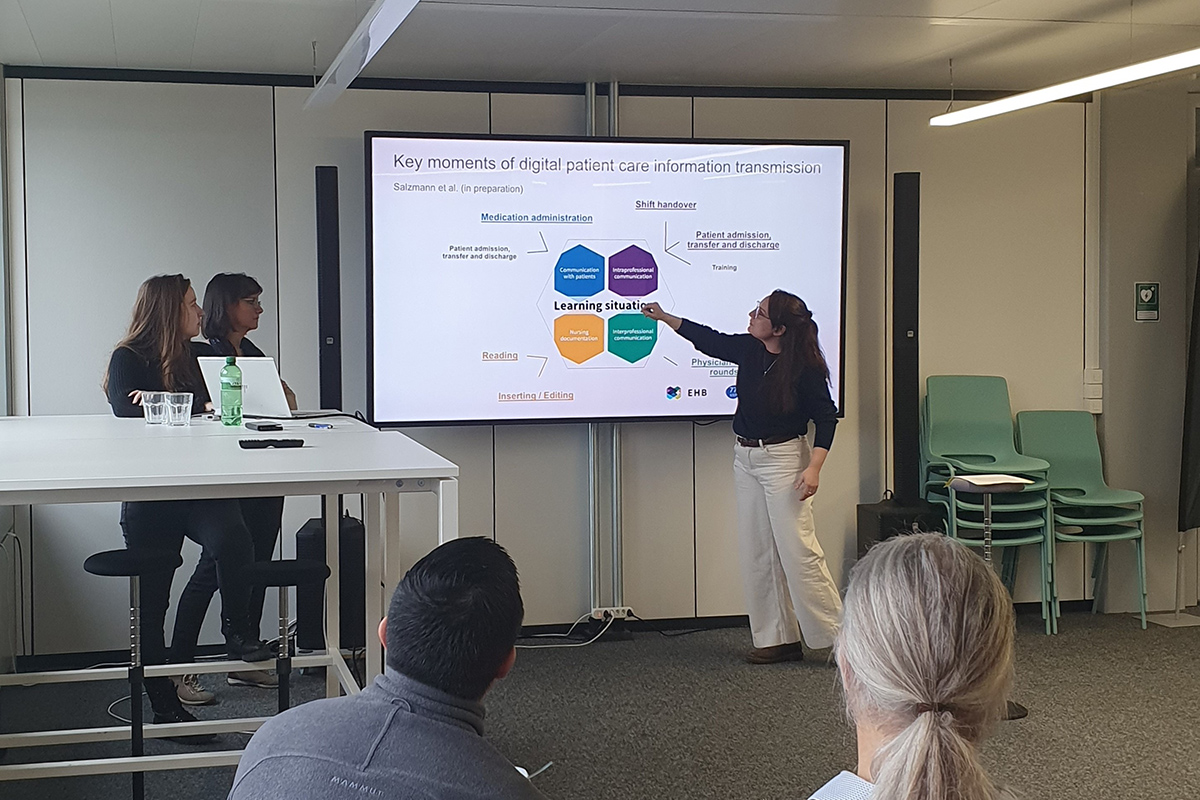
The main objective of the BeLEARN project “Digitalisation in healthcare” was to conduct an in-depth analysis of the extensive data gathered by the Digi-Care project. Key moments in the digital transmission and documentation of information in hospitals were identified, along with the digital competencies required by nursing staff to perform these tasks. A second objective was to obtain feedback on the VR prototype – an immersive and interactive 360-degree video on shift handover – which is intended to provide training on digital competencies that are so important today.
Method
The “course-of-action” approach to work analysis was used for the in-depth analysis of the ethnographic data (video recordings of job shadowing and self-confrontation interviews) collected as part of the Digi-Care project (Theureau, 2003, 2006).
Results
Results of this project can be seen in Digitalisation and transmission of clinical information in nursing: implications and perspectives (Digi-Care).
Implemented Translation
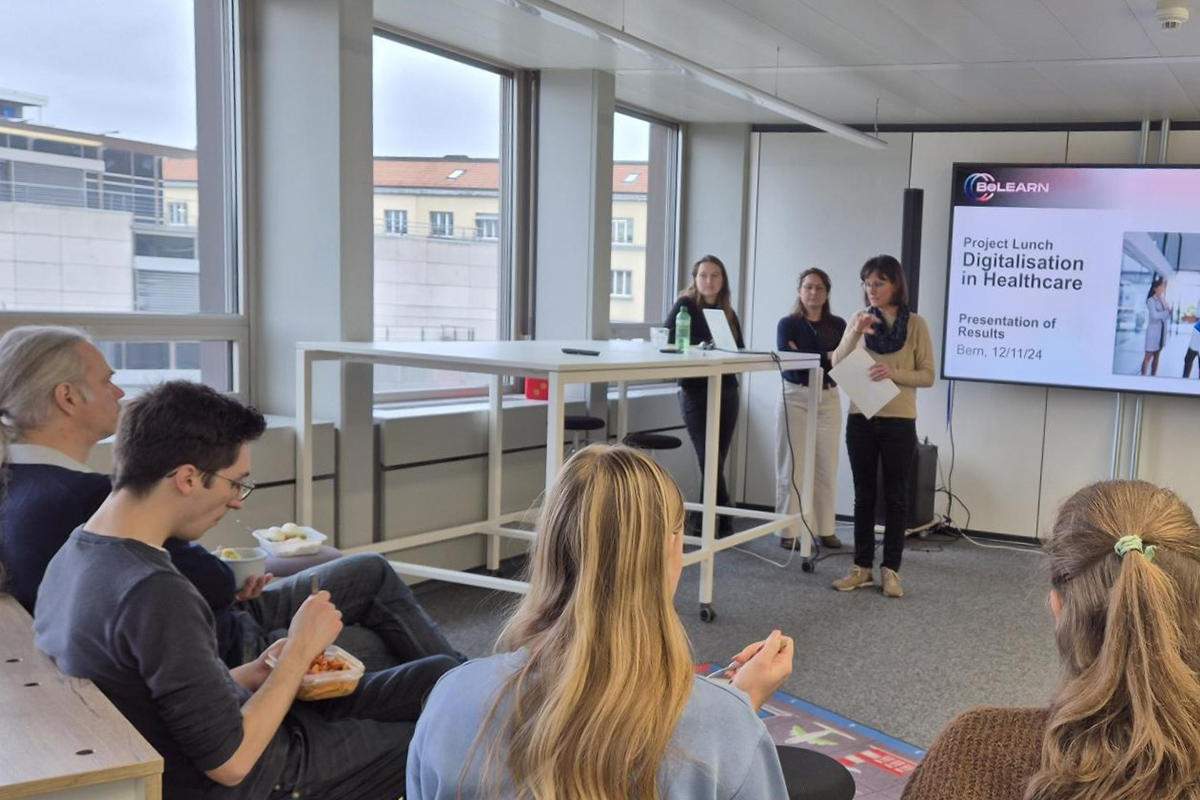
Numerous presentations were given to VET professionals, policymakers, and stakeholders, as well as at national and international scientific conferences.
Bürkle, T., Lueg, C., Lehmann, M., von Känel, F., Meier, L., Miletic, M., Hess, G., Schwarz, M., Fahrni, A., Moser, D., Löffel, K., Volpe, A. C., & Holm, J. (2024). Digi-care: Die Perspektive der Medizininformatik. In N. Albergati, L. Dorsa, M. Garbani-Nerini, F. Merlini, & D. Salini (Hrsg.), Entwicklung und Herausforderungen in der Pflegepraxis (Evoluzione e sfide delle pratiche infermieristiche) (Bd. 3, S. 45–51). Eidgenössische Hochschule für Berufsbildung (EHB).
Bürkle, T., Miletic, M., Löffel, K., Giunta, S., Bayraktar, Y., Salzmann, P., & Holm, J. (2024). Usability evaluation in a remote access scenario. Studies in Health Technology and Informatics, 315, 415–420.
Salzmann, P., Amenduni, F., Blanc, G., Bürkle, T., Löffel, K., Salini, D., Trede, I., & Volpe, A. C. (2024). Digi-care: Situierte, innovative und immersive Lernmaterialien für die Pflege. In N. Albergati, L. Dorsa, M. Garbani-Nerini, F. Merlini, & D. Salini (Hrsg.), Entwicklung und Herausforderungen in der Pflegepraxis (Evoluzione e sfide delle pratiche infermieristiche) (Bd. 3, S. 66–73). Eidgenössische Hochschule für Berufsbildung (EHB).
Salzmann, P., Löffel, K., & Volpe, A. C. (2024). Mit Virtual Reality in den Lernort Spital eintauchen: Aus- und Weiterbildung von Pflegefachpersonen. Skilled, 1, 13.
Salzmann, P., Volpe, A. C., Löffel, K., & Salini, D. (2025). Digital kompetentes Handeln in beruflichen Situationen. Skilled, 1, 22–23.
Volpe, A. C., Salzmann, P., Amenduni, F., Löffel, K., & Blanc, G. (2024). Digitale Kompetenzen werden auch in der Pflege immer wichtiger: Lerninstrumente für die Aus- und Weiterbildung von Pflegefachpersonen. Transfer. Berufsbildung in Forschung und Praxis, 9(9).
Volpe, A. C., Salini, D., Schmitz, M.-L., Löffel, K., Trede, I., Bürkle, T., & Salzmann, P. (2025). Digital competences of nursing staff for patient care information transmission: A semiological work analysis. Technology, Cognition and Work.