Alignment
BeLEARN is the national centre of competence for digital transformation in education. Together, we shape the teaching and learning of tomorrow — in an innovative, connected, and sustainable way.
Mission Statement
BeLEARN is a national centre of excellence for digital transformation in education. We promote innovative, interdisciplinary research and practical projects in the fields of Artificial Intelligence (AI), Digital Well-Being, Digital Skills & Literacy, Digital Tools, Digital Ethics, and Data Science for Education. Our goal is to advance the development of digital solutions with didactic and pedagogical added value at all levels of education and to anchor them in the educational landscape in the long term – together with our partners from education, research, and industry.
Reason to Be
The Setup: The Winds Are Picking up.
AI Fuels Digital Transformation
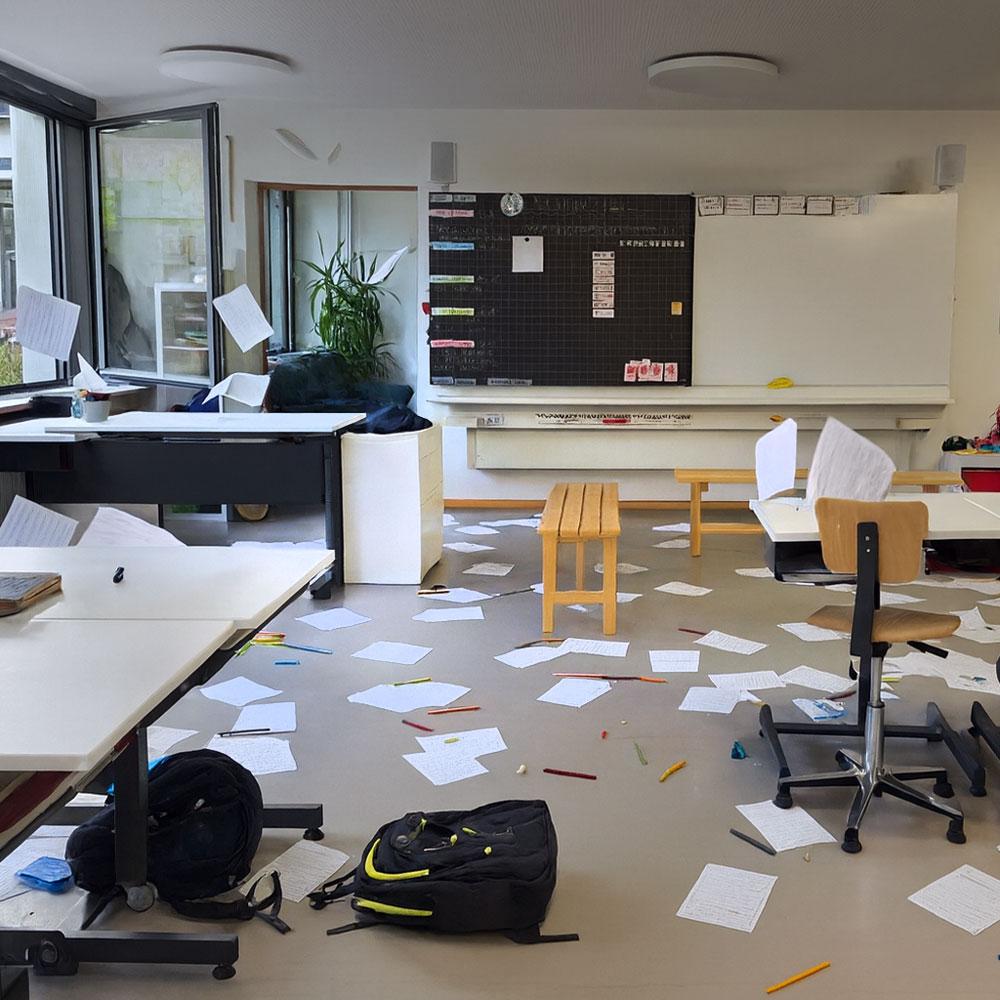
Digital transformation, fuelled by AI, can be compared to a storm sweeping through a house, sweeping away some firmly held beliefs, and turning everything upside down. It affects all areas – from didactics and pedagogy to data protection, ethics and parental involvement to technical infrastructure. And all at the same time.
Complexity and Pace Create Extreme Experiences
When rapid technological development meets a large and complex education system, extreme experiences for individuals, institutions and educational research are inevitable. These must cover a wide range of different skills. However, the necessary diversity of skills is rarely found under one roof, which is why interdisciplinary and cross-organisational cooperation is required. This is precisely what BeLEARN promotes in practice-oriented educational research.
The Added Value of BeLEARN
Complex issues can only be solved jointly — by bringing together different competencies. That is why BeLEARN unites stakeholders from research, educational practice, administration, and industry and supports interdisciplinary projects and event formats. The aim is rapid transfer into practice: insights from educational research should flow directly into education and society.
Our Value Proposition:
- Universities: access to interdisciplinary research projects and funding
- Educational practice: evidence‑based teaching methods with pedagogical and didactic value
- Companies: fresh impulses, e.g., for internal continuing education
- Administration: evidence‑based foundations for decision‑making
- Cantonal authorities: participation in research and co‑shaping of BeLEARN

FAQ
Read the answers to ten frequently asked questions about BeLEARN here:
BeLEARN initiates and supports practice-oriented educational research and facilitates the integration of the resulting innovations into the education system. To ensure this is successful, BeLEARN connects researchers with education practitioners, their institutions and businesses across cantonal and institutional boundaries. Furthermore, BeLEARN adapts research findings so that they can be used to inform education policy decisions. The overarching aim is to support the education system in making effective use of the potential offered by digitalisation. To this end, BeLEARN develops and tests practical solutions that bring about lasting improvements to the learning process and empower learners to actively meet the demands of society and the world of work.
Digitalisation is taking place across the board in the business world, and SMEs are feeling the effects first-hand: those who fail to attract digitally competent apprentices today will lose their competitive edge tomorrow. That is why new digital technologies should be integrated into vocational training wherever it makes sense to do so. Virtual reality, for example, demonstrates what is possible today: job-specific skills, ranging from spatial awareness in the plumbing sector to difficult patient consultations in the care sector, can be trained in virtual environments in a targeted and demonstrably effective manner. Such modern forms of learning are well received by young people and improve both the quality of training and the image of vocational education and training. This, in turn, helps to counteract the shortage of skilled workers. BeLEARN specifically supports projects that develop and test new digital teaching and learning methods with genuine educational added value, and actively assists them in integrating these into the education system.
The partnership with vocational schools is based on mutual benefit: the schools gain access to new, evidence-based educational tools that are open source. In return, BeLEARN projects receive valuable feedback from educational practice and can further develop their solutions accordingly. By the way: it is the head teachers and teachers themselves who decide whether to use an educational tool or a concept. BeLEARN makes the offer; the decision lies with the respective educational institution
As a general rule, a tool or concept is only introduced into the classroom if it can be demonstrated to enhance the learning process. Educational research is required to prove this. The SFUVET’s AR/VR app “Sketch to Pipes”, for example, promotes spatial thinking among trainee plumbers and is currently in use at three vocational schools. In collaboration with the Bildungszentrum Limmattal, a training programme has been developed that enables learners to identify defects in housing using interactive 360° images. Realistic scenarios for oral examinations in virtual environments are being used at SFUVET and the BBZ Olten. Another training programme uses 360° videos to teach future chefs about goods receipt, storage, and food preparation, and is now firmly established in the curriculum at the Allgemeine Berufsschule Zürich.
BeLEARN supports teachers and school management with practical, intuitively usable tools and expertise, with the clear aim of easing the burden of their demanding daily work. The resources are deliberately kept simple, requiring no lengthy training. For example, the “AI Orientation” provides up-to-date lesson ideas on AI and media literacy. “Inside ADHD” uses virtual reality to give an experience of what ADHD can feel like and offers a tried-and-tested pool of ideas for the classroom. With “XaraEdu”, teachers can practise challenging conversation scenarios virtually. All tools are available free of charge to primary schools in Bern.
There is a great deal of diversity in schools, and every child learns differently. Yet lessons often have to cater for everyone at the same time. Reliable AI-powered applications can help teachers provide exercises tailored to different ability levels. This applies to both children who struggle academically and those who excel. This takes the pressure off teachers and gives every child the opportunity to progress at their own pace. BeLEARN only supports projects that use technology to deliver genuine educational value, placing great emphasis on multilingualism, data protection, and data security.
As an educational institution, it is difficult to address questions relating to digital transformation in education on one’s own. This requires a wide range of expertise from fields such as AI, data protection, and programming, as well as psychology, pedagogy, and didactics. Such a diverse range of expertise is not usually found within a single institution. For this reason, BeLEARN brings together various experts as part of its research projects. To this end, BeLEARN offers a targeted incentive: funding is only awarded if at least two institutions are working together on a project. This fosters partnerships that combine different strengths. In recent years, numerous research partnerships have emerged across institutional and cantonal boundaries – efficiently, purposefully, and without duplication.
The digital transformation of education is recognised as a strategic priority throughout Switzerland and is funded accordingly. For instance, the Canton of Zurich has allocated CHF 300 million to the Digital Initiative of Zurich’s Universities (DIZH) for the period 2019–2029, and the Canton of St. Gallen has invested CHF 75 million over an eight-year period as part of its IT education initiative (ITBO). These programmes will come to an end in a few years, but the challenges remain. This is because digitalisation is an ongoing process. Furthermore, with the advent of artificial intelligence, a technology has emerged that poses fundamental questions for the education system. For example, it is not yet clear how AI can be used effectively in the learning process. Further coordinated efforts are needed here to answer these fundamental questions. These issues, which all levels of education are facing, will not simply resolve themselves.
Without BeLEARN, there would be no coordinating structure to bring together expertise on digitalisation and education in a targeted manner and to drive the transfer of educational innovations into practice. In concrete terms, this would have two consequences: Firstly, universities would continue to conduct research, but probably each on their own, without any coordination. The same questions would be investigated multiple times and synergies would remain untapped. Secondly, research findings would remain within the universities. There is no direct link to educational practice, and therefore no opportunity to develop solutions that are actually adopted in everyday school life.
BeLEARN is a lean organisation that can respond quickly to technological developments. This is crucial in times of rapid change. In recent years, BeLEARN has established a national research and innovation network that is constantly growing. Universities in Bern and elsewhere find within it the expertise they need for interdisciplinary projects in the field of digitalisation and education. This strengthens Bern as a centre for research and, consequently, as a business location. In this respect, BeLEARN is unique in Switzerland: no other organisation consistently follows the entire process, from defining research questions to integrating findings into educational practice.
Our Subject Areas
Our everyday lives are becoming increasingly digitised, which is why achieving and maintaining digital sovereignty is essential. To promote this, BeLEARN, as a centre of excellence for digital transformation in education, supports research and translation in the following areas:
About Artificial Intelligence (AI)
An AI system is a machine-based system designed to operate at varying levels of autonomy and capable of generating results such as predictions, recommendations or decisions that influence physical or virtual environments (AI Act). The spectrum of AI topics covers several sub-areas, such as: problem solving and search methods, knowledge representation and reasoning, planning, uncertainty and probabilistic models, machine learning, neural networks and deep learning, natural language processing, robotics and perception, multi-agent systems and reinforcement learning (Russell & Norvig, 2021).
Sources:
European Union (2024). Regulation laying down harmonised rules on Artificial Intelligence (AI Act).
Russell, S. J., & Norvig, P. (2021). Artificial Intelligence: A Modern Approach (4th ed.). Pearson.
About Digital Well-Being
The concept of digital well-being refers to the wellbeing of people in an increasingly digitalised world and aims to promote a healthy and balanced use of digital technologies (Baumann, 2024).
Digital well-being is treated as a separate strategic area of action in education policy at international and European level. In May 2025, WHO Europe published a policy brief on digital determinants of mental health in young people to support countries in formulating evidence-based policy responses to the increasing influence of digital technologies on well-being (WHO Regional Office for Europe, 2025). At European level, the EU Council adopted its own conclusions on supporting well-being in digital education in 2022 and calls on Member States to systematically integrate this aspect into their education strategies (Council of the European Union, 2022).
Sources:
Baumann, A. (2024). Digitales Wohlbefinden. Bayerisches Forschungsinstitut für Digitale Transformation (bidt). https://www.bidt.digital/glossar/digitales-wohlbefinden/
Council of the European Union (2022). EU highlights the importance of well-being in digital education. https://www.consilium.europa.eu/en/press/press-releases/2022/11/28/eu-highlights-the-importance-of-well-being-in-digital-education/
World Health Organization Regional Office for Europe (2025). Addressing the digital determinants of youth mental health and well-being: policy brief. https://www.who.int/europe/publications/i/item/WHO-EURO-2025-12187-51959-79685
About Digital Tools
Digital tools are – in the context of STEM teaching – specific digital applications and technical devices whose interactive functionality is used in a targeted manner to promote the acquisition of skills by learners and to support processes of knowledge acquisition (Roth et al, 2023).
Digital tools can help learners process information and construct knowledge from it. They enable individualised learning paths and provide immediate feedback, which makes it easier to take different learning requirements into account. Digital tools and assistive technologies demonstrate their potential particularly in the context of inclusion: they offer pupils with different abilities equal access to learning by personalising teaching methods, breaking down barriers, and promoting an accessible and equitable learning environment in which all learners can participate (Navas-Bonilla et al., 2025). At the same time, they promote collaborative working methods by facilitating communication and joint problem solving. In addition, digital tools contribute significantly to the development of key digital skills that are indispensable in a modern, technologised society and expand the didactic repertoire of teachers with new forms of teaching and learning.
Sources:
Navas-Bonilla, C. del R., Guerra-Arango, J. A., Oviedo-Guado, D. A., & Murillo-Noriega, D. E. (2025). Inclusive education through technology: A systematic review of types, tools and characteristics. Frontiers in Education, 10, 1527851. https://doi.org/10.3389/feduc.2025.1527851
Roth, J., Eilerts, K., Baum, M., Hornung, G. & Trefzger, T. (2023). Die Zukunft des MINT-Lernens – Herausforderungen und Lösungsansätze. In J. Roth, M. Baum, K. Eilerts, G. Hornung & T. Trefzger (Hrsg.), Die Zukunft des MINT-Lernens – Band 1. Springer Spektrum. https://doi.org/10.1007/978-3-662-66131-4_1
About Digital Skills & Literacy
While the topic of digital skills addresses the “what” and “how” of technology use – which tools are used and how they are operated – digital literacy broadens the focus to include the “why, when, who and for whom” (Bali, 2016). Digital literacy refers to the ability to use digital technologies safely and appropriately for information, communication, problem solving and the creation of digital content (Law et al., 2018) and includes critical judgement and ethical reflection.
BeLEARN treats digital skills and digital literacy as a single topic area, as technical skills without critical judgement are just as inadequate as reflective attitudes without practical application skills. Digital literacy is recognised at international, European, and national level as a strategically central competence for the 21st century and is anchored in education policy strategies and objectives:
- UNESCO: Inclusion of indicator 4.4.2 for SDG 4.4, which measures the percentage of youth and adults who have achieved at least a minimum level of digital literacy (UNESCO Institute for Statistics, n.d.).
- EU: The European Commission has developed guidelines for teachers to promote digital literacy and combat disinformation through education and training, emphasising that digital literacy has never been more important than in today’s increasingly digitalised world (European Commission, n.d.).
Sources:
Bali, M. (2016, 3. Februar). Knowing the difference between digital skills and digital literacies, and teaching both. Literacy Worldwide. https://www.literacyworldwide.org/blog/literacy-now/2016/02/03/knowing-the-difference-between-digital-skills-and-digital-literacies-and-teaching-both
European Commission (o.J.). Guidelines for teachers to foster digital literacy and tackle disinformation. https://education.ec.europa.eu/focus-topics/digital-education/action-plan/guidelines-for-teachers-to-foster-digital-literacy-and-tackle-disinformation
Law, N., Woo, D., de la Torre, J., & Wong, G. (2018). A global framework of reference on digital literacy skills for indicator 4.4.2 (UIS Information Paper No. 51). UNESCO Institute for Statistics. https://unesdoc.unesco.org/ark:/48223/pf0000265403
UNESCO Institute for Statistics. (o. J.). Monitoring framework. Abgerufen am 5. November 2025 von https://www.uis.unesco.org/en/gaml/monitoring-framework
About Digital Ethics
Digital ethics refers to a subfield of applied ethics that deals with the moral and normative issues of digital transformation. Building on information and media ethics, it examines which values and principles (e.g. autonomy, justice, privacy, transparency, responsibility) should guide the development, design and use of digital technologies – in particular data processing, algorithmic systems, and artificial intelligence – in individual, organisational, and social contexts, and how these can be implemented in practice.
Sources:
Fenner, Dagmar (2025): Exkurs: Digitale Ethik. Bundeszentrale für politische Bildung. Online. bpb.de
Filk, C. (2025). Strengthening Digital Self-Determination: Integrating Media Ethics and Artificial Intelligence into Teacher Training for Everyday School Life. In: medienimpulse, Bd. 63, Nr. 1. https://doi.org/10.21243/mi-01-25-29
About Data Science for Education
Data science for education refers to an interdisciplinary field of research and application that applies data science methods – including statistical analysis, machine learning, data mining, and data visualisation – to educational data in order to examine, predict, and improve teaching and learning processes, educational decisions, and education systems in an evidence-based manner. It combines data analysis methods with educational theory, taking into account the pedagogical, organisational and ethical context of data use in education.
Data science in education offers significant potential for the further development of research, teaching, and education systems. By integrating data science methods with pedagogical expertise, educational institutions can make data-informed decisions, design personalised learning environments, and better understand complex learning processes. At the same time, this field requires a high degree of sensitivity to ethical challenges, particularly with regard to data protection, fairness, and transparency. The research papers listed below show that data science in education can only be effective in the long term if technological possibilities and educational responsibility are considered together.
Sources:
Gašević, D., Dawson, S., & Siemens, G. (2015). Let’s Not Forget: Learning Analytics Are About Learning. TechTrends, 59, 64–71. https://doi.org/10.1007/s11528-014-0822-x
Han, J., Kamber, M., & Pei, J. (2011). Data Mining: Concepts and Techniques (3rd ed.). Morgan Kaufmann. https://doi.org/10.1016/C2009-0-61819-5
Ifenthaler, D., & Yau, J. Y.-K. (2020). Utilising Learning Analytics for Study Success: Reflections on Ethical and Data-Protection Considerations. Educational Technology Research and Development, 68, 421–426. https://doi.org/10.1007/s11423-020-09788-z
Martínez-Maldonado, R. (2019). Designing Learning Analytics for Educational Data Science. British Journal of Educational Technology, 50(6), 2763–2777. https://doi.org/10.1111/bjet.12871
Prinsloo, P., & Slade, S. (2017). An Elephant in the Learning Analytics Room: The Ethical Challenges of Learning Analytics. Journal of Learning Analytics, 4(1), 3–19. https://doi.org/10.18608/jla.2017.41.2
Suthers, D., & Verbert, K. (2013). Learning Analytics. American Behavioral Scientist, 57(10), 1410–1425. https://doi.org/10.1177/0002764213498851