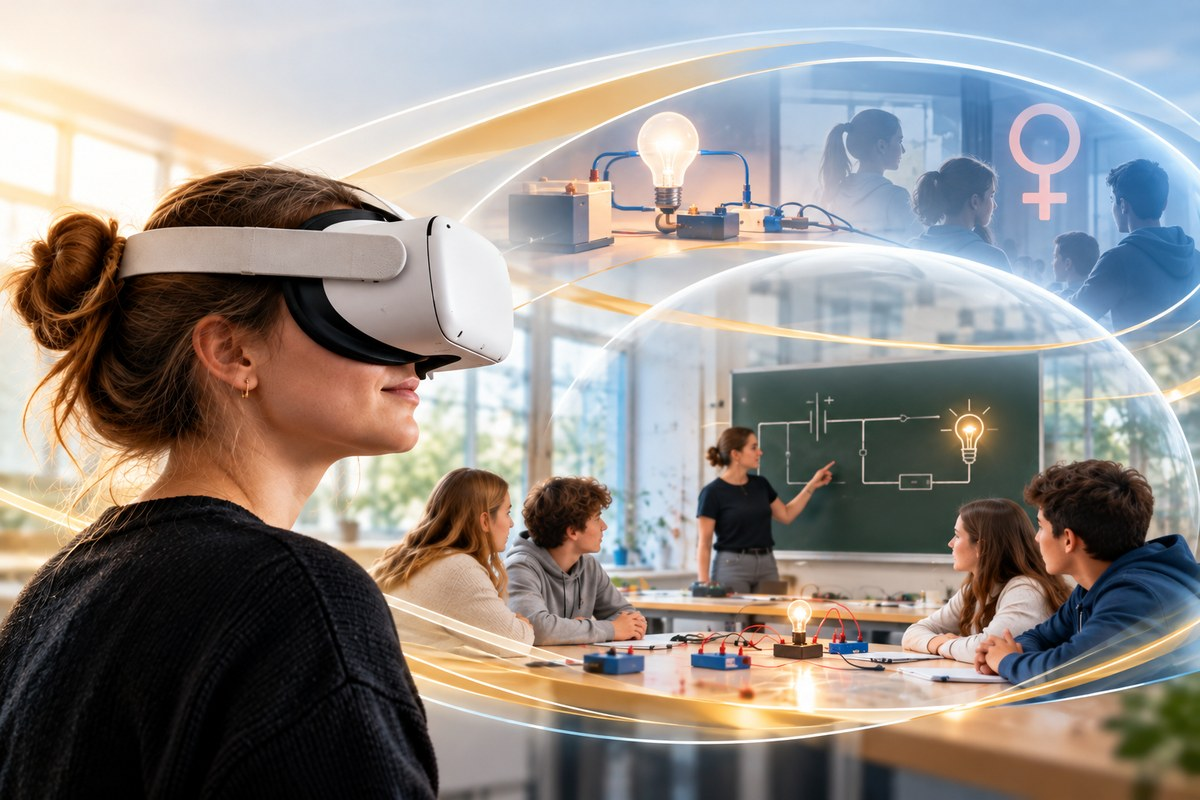
Development of a VR classroom to enhance professional vision among pre-service science teachers
An AI-powered VR classroom enables future science teachers to develop professional vision through immersive and interactive teaching simulations.
Duration: 1 January 2027 – 31 December 2027
Status: Planned
Educational Level: Tertiary Level
Topic: AI (Artificial Intelligence), Digital Tools
Keywords: Virtual Reality (VR); Artificial Intelligence (AI); Professional Vision; Science Teacher Education; Interactive Classroom Simulation
Initial Situation
Teaching practicums are a core component of teacher education. During the practical phase of their training, students acquire key competencies and apply research-based knowledge to real-world situations. At the same time, practicum settings are limited in terms of both time and content and require a significant amount of organizational effort. Furthermore, specific learning situations for students in practicums are only partially controllable and are often focused on general teaching content such as classroom management. Subject-specific teaching competencies and actual subject-specific learning cannot be addressed to the desired extent.
This challenge can be partly addressed through video vignettes in teacher education. The benefits of video-based classroom analysis are well documented: authentic representations of classroom processes foster pre-service teachers’ reflective skills and contribute to the development of their professional competencies. However, previous research on professional vision in science education has predominantly relied on non-immersive, two-dimensional classroom videos. These offer limited opportunities for interaction and for exploring classroom situations from different perspectives. This project aims to overcome these limitations by developing an interactive 3D classroom environment in which pre-service teachers can further develop and train their professional vision.
Objectives
This project aims to develop and evaluate an interactive VR classroom with AI-powered student avatars to foster professional vision in pre-service science teachers. Building on a previous BeLEARN project, the environment enables realistic interactions focusing on students’ preconceptions about electrical circuits and gender-sensitive teaching. The study investigates user acceptance, cognitive load, and how immersive interactions support knowledge-based reasoning and pedagogical decision-making.
Method
The project follows a mixed-methods design. First, an interactive VR classroom with AI-powered student avatars is developed using Unity and Meta Quest 3. The avatars simulate realistic teaching situations focusing on students’ preconceptions about electrical circuits and gender-sensitive teaching. In an iterative process, the VR environment is tested and refined. Pre-service teachers then interact with the avatars in immersive teaching scenarios. Cognitive load and user acceptance are assessed through questionnaires. Screen recordings and guided interviews are qualitatively analysed to investigate professional vision, particularly noticing, knowledge-based reasoning, and pedagogical decision-making.
Planned Translation
The VR classroom will be integrated into science teacher education at PH Luzern. Pre-service teachers will be involved in early development stages to provide feedback and improve the tool. The platform will subsequently be implemented in teacher education modules and shared with lecturers and practising teachers through professional development activities. Collaboration with CKW, PH Bern, and events such as the SWiSE Innovation Day will support dissemination. The technology will also be introduced to other departments at PH Luzern and made available for future educational projects at BFH.
The project aims to enhance science teacher education through an innovative, interactive VR training environment designed to foster professional vision. Through realistic interactions with AI-powered student avatars, pre-service teachers can practise identifying and interpreting subject-specific teaching situations and making informed pedagogical decisions. The impact will be investigated using a mixed-methods approach, including questionnaires assessing cognitive load and user acceptance, as well as screen recordings and guided interviews to examine noticing, knowledge-based reasoning, and pedagogical decision-making. Furthermore, the VR platform offers potential for broader integration into teacher education.