Bern Digital Skills Platform
Enabling cross-university digital skills programmes through the three universities in Bern.
Duration: January 2023 – June 2023
Status: Completed
Educational Level: Tertiary Level
Topic: Digital Skills & Literacy, Digital Tools
Keywords: Digital Skills, Learning Platforms
Initial Situation
It is foreseeable that demand for digital skills courses will increase among both students and the professional world. This will bring elective courses, such as supplementary programming courses and the acquisition of practical data skills, further into the spotlight. The Bern Digital Skills Platform aims to promote high-quality teaching in the field of digital skills and strengthen the joint university location.
Objectives
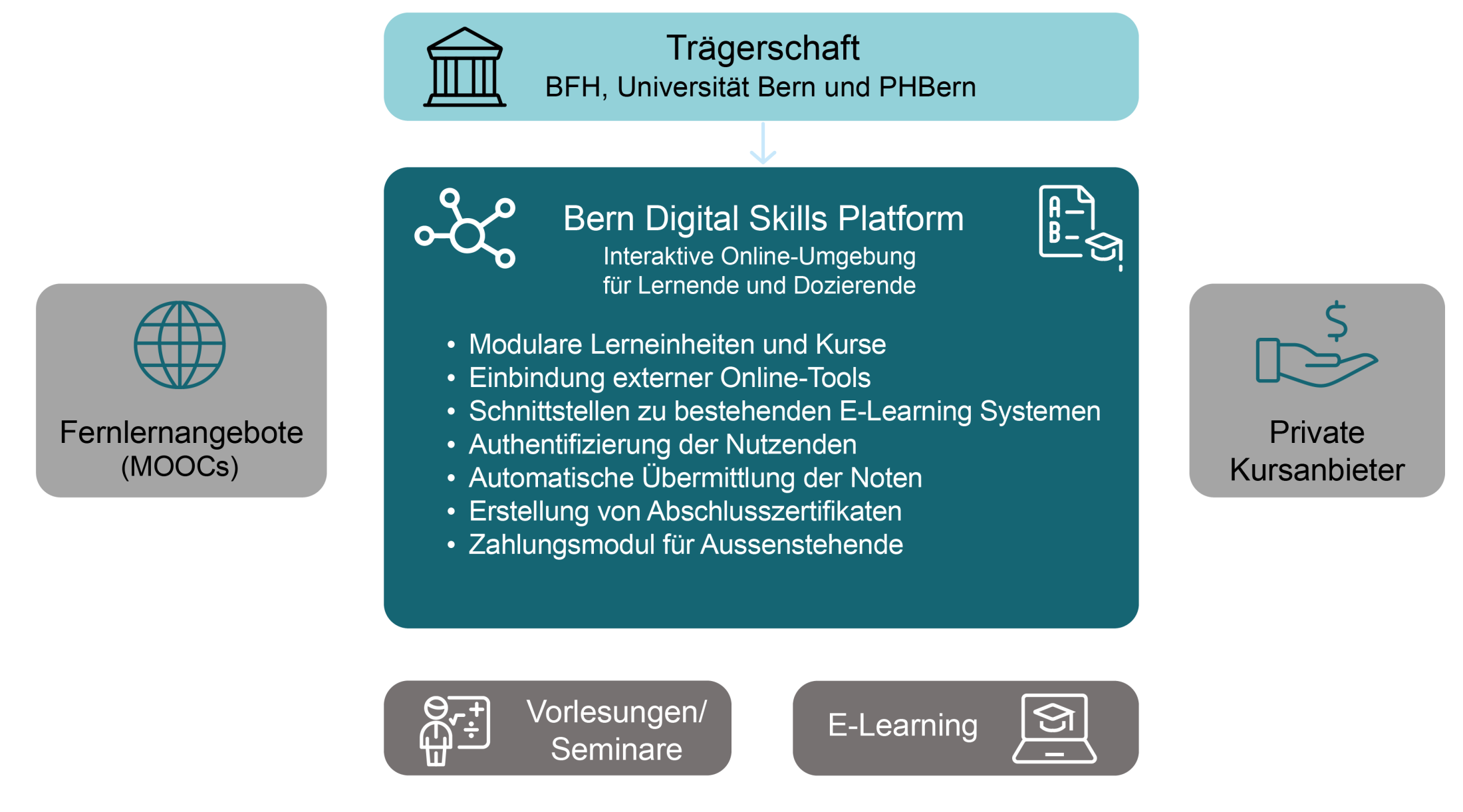
Synergies are to be utilised by involving the Bernese universities BFH, University of Bern and PHBern.
Advantages of a cross-university Bernese platform:
- Adaptation to degree programmes at Bernese universities
- On-site coaching of participants in German (and English if required)
- Attractive courses, including for university staff
- Modular structure of course content to cover every level
- If the platform is opened to the general public: income from external fees (Certificate of Open Studies, official confirmation from Bernese universities)
- Strengthening of Bern as a location, improved visibility of universities
- Enables evaluation of courses through follow-up projects in the spirit of translation
Method
First, research was conducted on existing courses and offerings at the three universities. Subsequently, discussions were held with lecturers of relevant courses to explore opportunities for further development and transfer. In parallel, between January and May 2023, discussions were conducted with representatives of the Vice-Rectorate for Teaching at the University of Bern, the Virtual Academy and Continuing Education at BFH, and the Digital Transformation Network at PHBern. These conversations aimed to assess the interest in and potential of a “Bern Digital Skills Platform” and to incorporate these findings into the detailed concept. Discussions with lecturers also explored whether and how such a platform could benefit their current teaching activities.
Results
Numerous discussions with lecturers have confirmed that there is a willingness to adapt existing programming and statistics courses for a new, cross-university online platform and to open them up to new participants. Several lecturers also consider it sensible to integrate individual or several modular course components into existing curricula. On this basis, a detailed concept was developed that outlines how the establishment and long-term operation of a new online platform offering “Digital Skills” courses for students and the general public can be successfully implemented both in terms of content and financial sustainability.
Implemented Translation
The detailed concept “Bern Digital Skills Platform” pursued several objectives: on the one hand, it aimed to provide a comprehensive overview of the existing teaching offers in the field of digital skills and to identify any redundancies. On the other hand, it outlined a potential solution approach in the form of a possible “Bern Digital Skills Platform.” The aim of the project was to assess the needs and to develop a detailed concept for a “Bern Digital Skills Platform.” The implementation of the platform itself was not part of this project and has not yet been realised due to a lack of funding.
The project provided a sound basis for decision-making regarding the potential development of a cross-institutional “Bern Digital Skills Platform.” The needs assessment among instructors and the strategic discussions with representatives of the three Bernese higher education institutions confirmed the interest in a shared online platform for programming and statistics courses. The detailed concept developed in the project demonstrates how existing content can be structured modularly, aligned across institutions, and integrated into existing curricula in order to avoid redundancies. It addresses both the pedagogical and economic aspects of establishing and sustaining a platform that could serve students as well as the general public. Although implementation could not be realised due to a lack of funding, the project documents a strong willingness for cross-institutional collaboration in the field of digital skills and provides a valuable foundation for future initiatives.


