Monitoring for Empowering Trainers and Student Teachers in the Implementation of Digital Competencies
We explore how the Digital Training Companion, leveraging data science and AI, enhances the monitoring and follow-up of training in digital competencies.
Duration: February 2024 – December 2024
Status: Completed
Educational Level: Tertiary Level
Topic: Artificial Intelligence AI, Data Science for Education, Digital Skills & Literacy
Keywords: Data Science, Digital Skills, Large-Scale Assessment, Process Data
Initial Situation
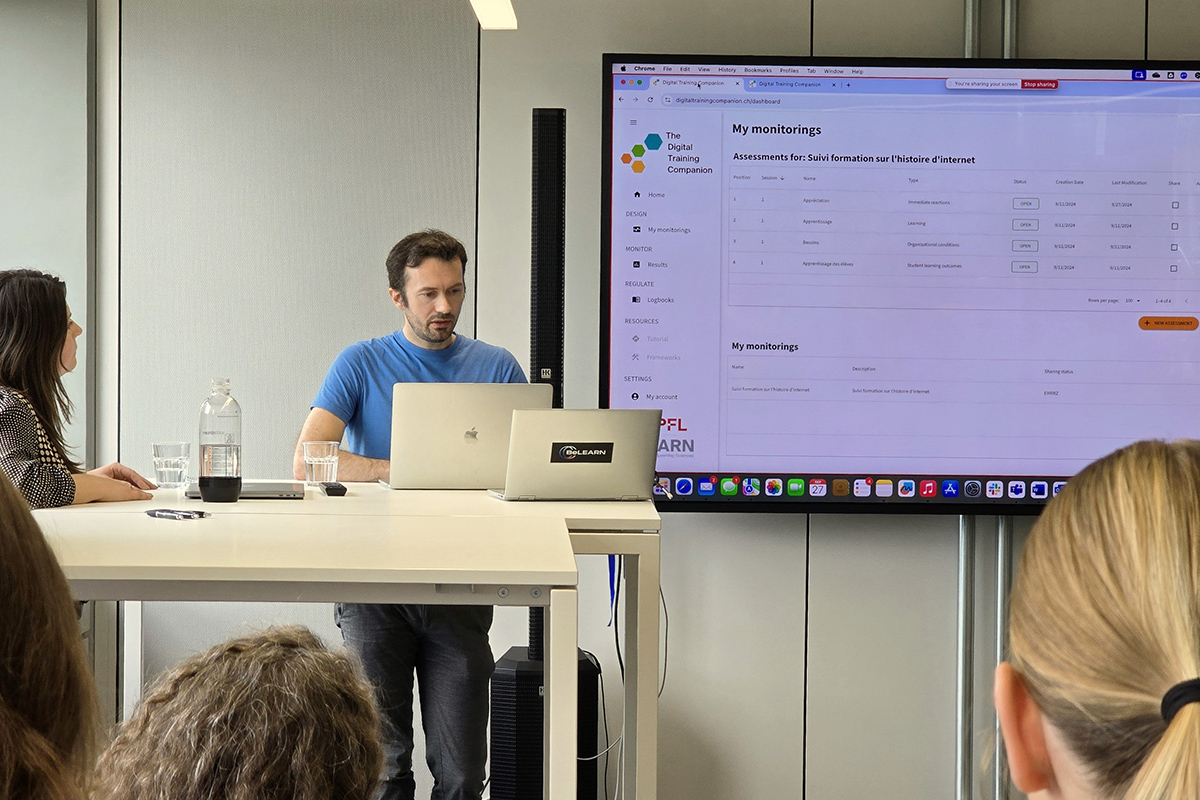
As part of the EduNum reform in the Canton of Vaud, a framework was developed to improve the initial and continuing training of teachers in the field of digital education. This framework included a comprehensive evaluation model as well as a data collection methodology. Building on this, our project examines the effectiveness of the “Digital Training Companion” (DTC), a web based platform. Our research findings feed into new features of this web application and promote a continuous improvement process in teacher education for digital education. The application supports teacher trainers and teachers in continuously evaluating the different phases of training.
Follow-up Project
The follow-up project, The Digital Training Companion, examines how the DTC influences the quality of digital skills training. It also explores how the DTC supports knowledge transfer at the student level, thereby promoting learning and motivation among learners in digitally enriched teaching units.
Objectives
The project aimed to evaluate the effectiveness of the DTC. The DTC combines data based self evaluation, result visualisation and reflection tools in order to foster the development of teachers’ digital competencies.
Method
The DTC was tested in teacher training with student teachers and their trainers. The platform offers functions for creating assessments, for capturing and visualising results as well as digital logs. Project participants used these for formative assessment and reflection. Trainers were trained in how to use it. In addition, a 3 ECTS course “Subject oriented teaching with digital technologies” was developed, in which student teachers planned teaching scenarios, received feedback and created their own assessments in accordance with Lehrplan 21.
Results
All main features of the DTC were successfully implemented and integrated. Initial data on self assessment of digital competences and on the motivation to use digital technologies were collected through questionnaires and interviews. Also, structured assessments across five learning domains were gathered. The evaluation revealed the support needs of teachers as well as potential for improvement of the platform in everyday training practice. On the basis of usage analysis, a roadmap for further development was drawn up.
Implemented Translation
The platform was directly integrated into education: trainers used it for formative assessment and for planning lessons with digital technologies. Student teachers developed their own teaching units using the DTC and tested them during internships. In this way, research findings could be transferred into practice in teacher training and teaching. The training of trainers supported the sustainable anchoring in instruction.
The project supported the building of digital competences in student teachers and promoted data based reflection and lesson development. The use of the DTC enabled systematic and formative support of digital education. Insights from the project fed into the further development of the platform and the planning of the follow up project, “The Digital Training Companion”.
Ittner, D., Notari, M., Pannatier, M., & Avry, S. (2025). Transforming evaluation culture in secondary schools: A case study on the Digital Training Companion [Research workshop proposal submitted for the European Conference on Educational Research (ECER), European Educational Research Association (EERA), Belgrade, Serbia].
Pannatier, M., Avry, S., Monnier, E.-Ch., El-Hamamsy, L., Caneva, C., & Dehler Zufferey, J. (2024). Monitoring of teachers’ digital professional development: A revised model. In Leading the future of learning: Proceedings of the Innovating Higher Education Conference 2024 (pp. 130–144). European Association of Distance Teaching Universities (EADTU). https://doi.org/10.5281/zenodo.14220974
Pannatier, M., & Avry, S. (2025). Empowering trainers and student teachers in development and implementation of digital competences [Conference presentation proposal submitted for the EARLI 2025 Conference, Graz, Austria].
Pannatier, M., Avry, S., & Notari, M. (2025). A subject-related digital training course as a means for empowering trainers and student teachers in monitoring and evaluation of digital competences [Conference presentation proposal submitted for the SSRE–SGL Annual Conference 2025, Lucerne University of Teacher Education, Lucerne, Switzerland].