Mapping of Teachers’ AI-Related Competences in Vocational Education
In this project, researchers from the FFHS and SFUVET aim to assess the current status quo of AI competences among teachers in vocational education.
Duration: January 2025 – January 2026
Status: Completed
Educational Level: Upper Secondary Level – Vocational Education
Topic: Artificial Intelligence AI, Digital Skills & Literacy
Keywords: Digital Competence, Artificial Intelligence, Vocational Teachers
Initial Situation
The advent of artificial intelligence (AI) affects many areas, the educational sector notwithstanding. Given the potential effects of the introduction of AI in professional contexts, educators in general as well as in vocational education need to be able to impart the respective competences onto their students to prepare them for these challenges. A necessary condition for this endeavour is that teachers and instructors possess the respective competences themselves in the first place, which requires a valid tool to assess them.
Objectives
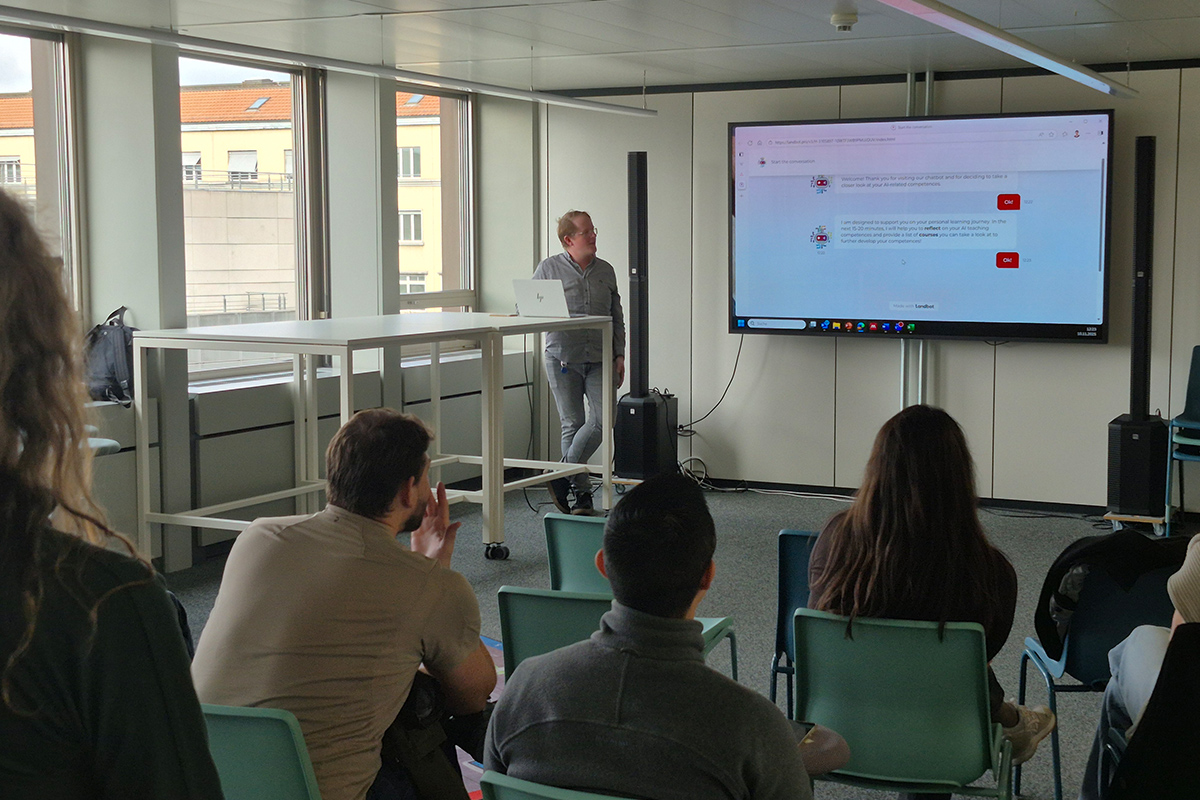
We aimed to assess the status quo of AI competences among teachers in vocational education by creating an AI-specific questionnaire based on well-established theoretical models of digital competences. Based on their scores in the questionnaire, participants were provided an individual profile of their AI-related competences. A second goal was to validate the questionnaire. Lastly, we created a framework for a counselling model in the form of a chatbot prototype which, using the individual profiles as starting point, provides participants with recommendations for further competence development.
Method
Based on a literature search of theoretical models of teacher’s AI-competences a new questionnaire was designed, implemented and then validated on a sample of vocational education teachers. Furthermore, a counselling framework prototype was designed that builds on the teachers’individual competence profiles and provides recommendations for further competence development.
Results
The questionnaire was validated with a sample of more than 400 vocational teachers. Results show that despite a strong theoretical reference is necessary to build a new instrument on AI-related digital competences, referring to existing models can be insufficient to take care of the specificities of this new area. Therefore, for example, it is essential to go beyond the traditional six competence areas of the DigCompEdu framework to take into account specific issues like the ethical implications of AI. Similarly, the topic is still so under development, that finding good and definitive resources for improving one’s profile is still an open challenge.
Implemented Translation
Translation is somehow inherent to the project, as since its early phases teachers from vocational schools were involved directly in their own AI-related digital competence assessment. But beyond this, once the tool will be validated, translational activities can be planned in the framework of both initial and further education, for example at SFUVET, and specific training offers on AI use can be designed to include the questionnaire as a starting reflective point. Similarly, the counseling framework can become a self-standing tool to promote and improve AI-related digital competence of teachers, in VET as well as in other educational levels.
This project has the potential to encourage teachers in vocational education to engage with the topic of AI competences and gain a better understanding of their own level of competence. In addition, the counseling framework provides teachers with information on possible ways to improve in the areas that may still be lacking. This project can therefore contribute to improving the AI competences of vocational school teachers.