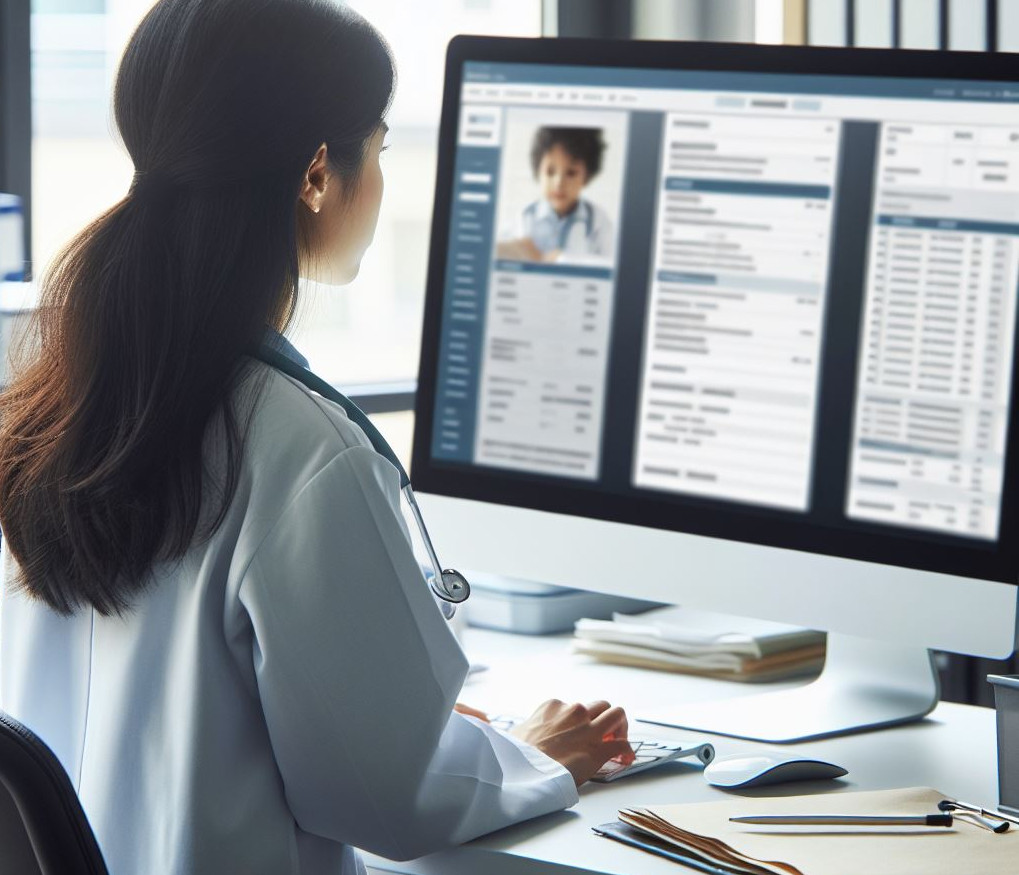
Machine Learning-Based Feedback Support for Blended Learning in Medical Studies
Blended Learning is used to prepare medical students for real-life situations, and for effective learning, students and teachers need detailed feedback.
Duration: January 2025 – December 2025
Status: Ongoing
Educational Level: Tertiary Level
Topic: Artificial Intelligence AI, Data Science for Education, Digital Tools
Keywords: Blended Learning, Virtual Patients, Learning Analytics, Machine Learning, NLP
Initial Situation
Online learning tools are common in medical education, especially since the Covid pandemic. One popular tool is Virtual Patients (VPs). These are interactive cases where students make decisions like a real doctor would. At Bern Medical Faculty, all medical students use VPs, for example in emergency medicine. Modern technology allows to track how students interact with these tools. During VP sessions, students answer questions about patient history, physical exams, possible diagnoses, and treatments. Their answers can be recorded and analyzed later using Learning Analytics (LA), which looks for patterns in learning behavior. Outside medicine, LA is widely used to monitor student engagement in online courses, but in healthcare education, it’s still rare. Free-text summaries written by students are also useful because they show how well a student understands and organizes patient problems – key for good clinical reasoning. While VPs are generally well-liked, feedback is an area that needs improvement. Currently, students do not get a clear overview of their performance or how they compare to peers. When writing patient summaries, they only see an expert’s answer, not personalized feedback.
Objectives
Virtual Patients (VPs) are widely used in medical education, but feedback can be improved. We are developing two prototypes for blended learning: one uses NLP to assess and visualize students’ narrative summaries, and the other shows learning analytics of all VP interactions and answers. Both students and teachers will join focus groups to evaluate how helpful these feedback tools are when integrated into medical courses.
Method
We will create a dataset from Virtual Patient (VP) cases used by medical students at the University of Bern, covering different emergency scenarios. For analyzing students’ narrative summaries, we’ll apply NLP methods and annotate texts based on SBAR (Situation, Background, Assessment, Recommendation). We aim to design feature extraction and classification models, evaluate them, and visualize results to support learners and teachers. A second prototype will display learning analytics of all VP interactions. Both tools will be tested in focus groups to assess their usefulness for feedback.
Planned Translation
The developed prototypes will be implemented and evaluated by means of a pilot project within a regular blended learning course for medical students at the Medical Faculty of the University of Bern. If evaluated positively, it is intended to establish both developed prototypes as standard in these courses. We envision that students will receive interactive feedback via a dashboard that contains the visualization of all learning analytics data. Further they will get an individual assessment of their narrative summary of the respective case. This will allow students to get better insights where their strengths and weaknesses are, improving the overall learning experience and the learning rate. Teachers will use the dashboard results before moderating a synchronous session after students worked through the VPs. This will allow teachers to both get insights on how students performed within the VPs before the session to focus on weaknesses of the students during the synchronous session and further to provide individual feedback to students by being better informed.