The movement suitcase: remembering and recalling movements Quick Implementation
This exercise is the moving form of "I pack my suitcase". A movement chain grows from child to child, each repeats the whole series from memory and adds their own movement. The aim is to train working memory through the body, remembering and recalling a growing sequence. Children with a strong urge to move benefit in particular, because remembering here runs through movement and not through sitting still.
Key Information
Subject/ Subject Area: Cross curricular / Working memory and movement
School Level: Cycle 1 and 2
Implementation
The principle
A movement chain grows from child to child. Each child repeats the whole previous series from memory and adds their own movement. Remembering runs through the body, not through sitting still.
How the basic form runs
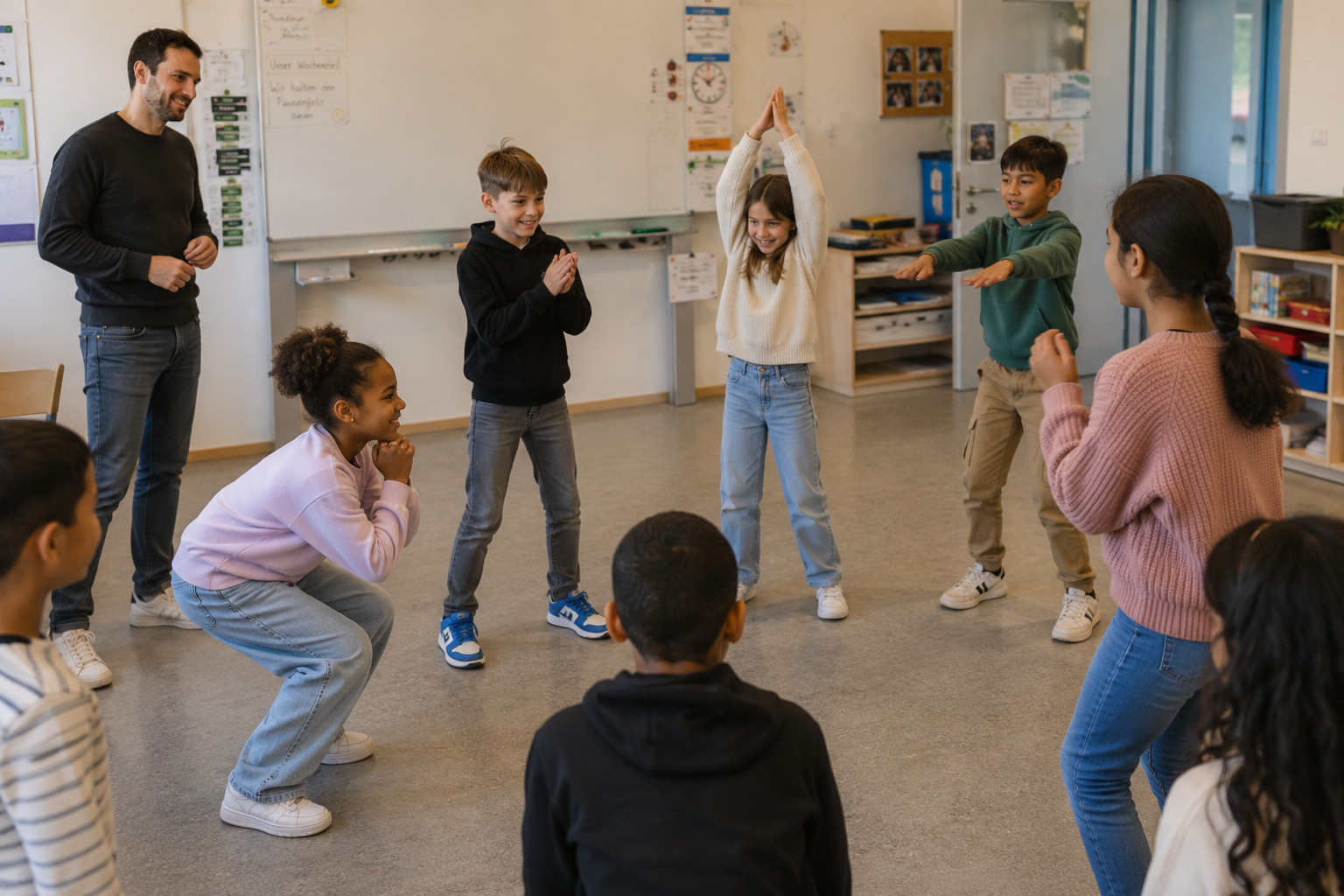
The class stands in a circle. One child makes a movement, for example a squat. The next child repeats it and adds their own, for example squat, then clap. The third does both and adds a third. This way the chain grows child by child. If it breaks, it starts again, and the class tries together to beat its own record. It is not about being out, but about the shared length.
How to bring it into lessons
Instead of random movements, link to a topic. Syllables become jumps, a calculation chain with its steps a movement sequence, vocabulary matching gestures. This turns the memory game into a learning exercise that fits the current topic.
How to deepen it
Recall the series backwards, which draws more on working memory. Or build in a rule that changes along the way, for example every third movement is only thought silently and not shown, which adds inhibition. Later, children lead the round themselves.
The gentle frame
No elimination, a mistake simply resets the chain, so that enjoyment comes before embarrassment. Keep the chains short and increase the length slowly. And make sure children who remember less easily are not pushed to the end of the series, but go early, when the chain is still short.
The pitfalls
Chains that are too long overwhelm and frustrate, better several short rounds. Too fast a pace makes the movements sloppy, calm, clear movements support remembering better. And choose movements simple enough for everyone to follow.
References
After: Selin Güler, primary school teacher and Translationmanager at BeLEARN
Sources: adapted from ‘I pack my suitcase’ (Walk & Evers, 2013; fit4future and DSBG, Übungssammlung Exekutive Funktionen, 2017)