Reaction game: Toaster
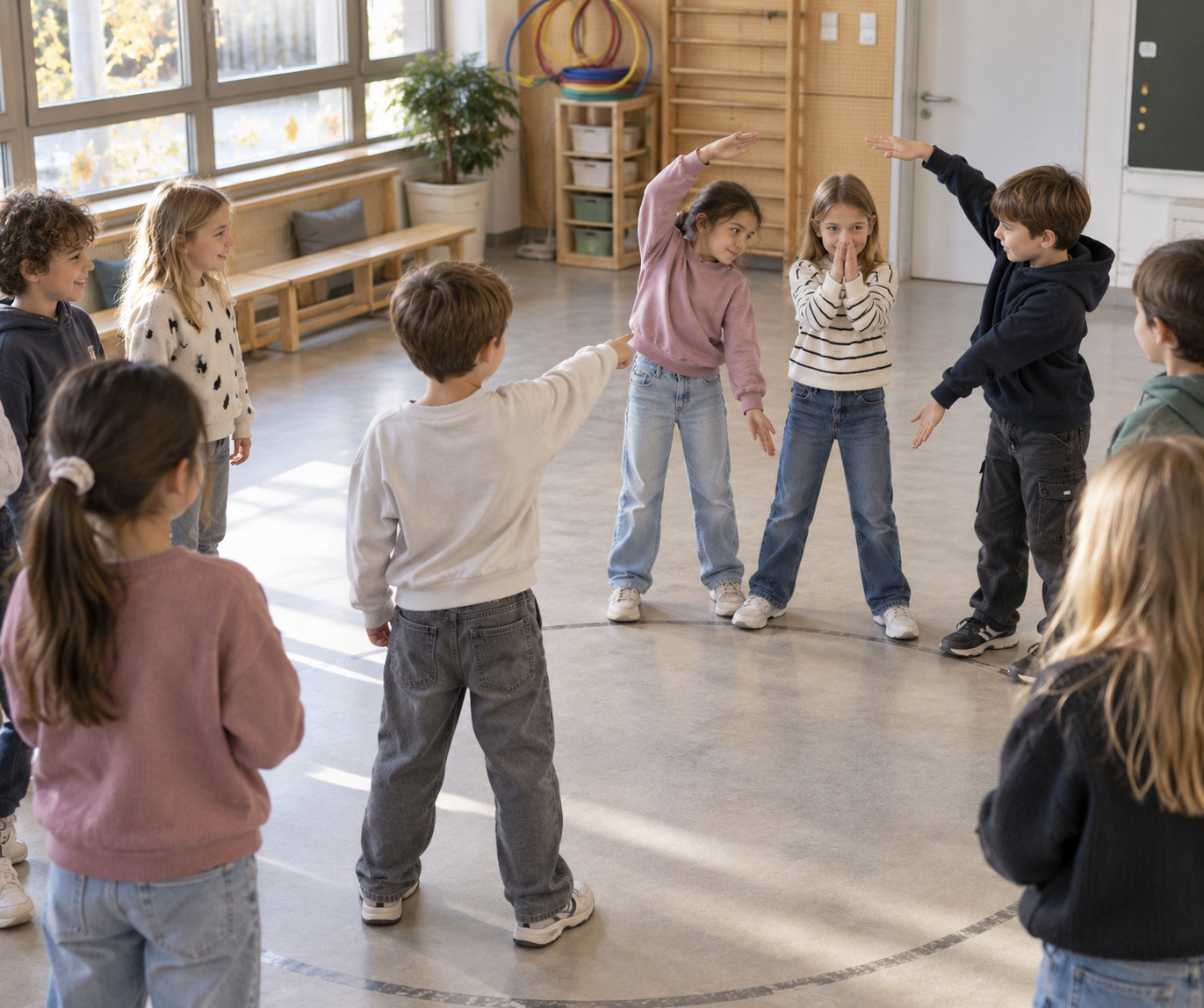
Reaction and concentration game played in a circle. One person stands in the middle, points to another player and names a figure. The person selected and the two players next to them must immediately act out the figure.
Key Information
Subject(s): Cross-curricular
School level(s): Cycles 1 and 2
Cross-curricular competencies: personal competencies (self-regulation and attention management), social competencies (cooperation and dealing with mistakes) and methodological competencies. The game activates the executive functions underlying these competencies.
Implementation
The game develops attention, working memory, reaction speed, impulse control and cognitive flexibility—key executive functions.
How to play
Everyone stands in a circle. One child chosen by the teacher stands in the middle and leads the game. This child points to any player and calls out one of the agreed figures. The selected player and the two players next to them must perform the figure as quickly and accurately as possible. Anyone who takes too long, hesitates or makes the wrong movement moves to the middle and selects the next player.
Start with three to five figures and only add more once these have been mastered. Practise each figure together beforehand. Choose simple figures for younger children and demonstrate them thoroughly. For older students, a brief verbal description at the beginning is sufficient. Keep the pace high: if selecting the next player takes too long, the game loses momentum. Present moving to the middle as taking on a new role rather than as a punishment, and encourage a positive attitude towards mistakes.
Collection of figures
All these figures can be performed silently, using only movements and postures.
• The three monkeys. Middle: covers their eyes. Sides: the person on the right covers their ears and the person on the left covers their mouth.
• Toaster. Sides: hold hands to form the toaster. Middle: jumps up between them like a piece of toast.
• Washing machine. Sides: hold hands. Middle: puts their head between their arms and turns it quickly.
• Elephant. Middle: forms a trunk with their hands. Sides: each forms an ear with their arms.
• Blender. Middle: stretches their arms above the heads of the two players on either side. Sides: turn around in a circle.
• Palm tree. Middle: stretches their arms upwards, with their hands hanging down like palm fronds. Sides: lean outwards like drooping leaves.
• Kangaroo. Middle: forms a pouch in front of their stomach with their arms. Sides: jump on the spot.
• Superhero. Middle: stretches one fist forwards as if flying. Sides: use their arms to make the cape billow.
• Flower. Middle: rests their face in their open hands to represent the flower. Sides: use their arms to form leaves.
• Duck. Middle: forms a beak with their hands and waddles. Sides: flap their arms like wings.
• Fish. Middle: makes a fish mouth and moves their hands like fins. Sides: move their arms in waves to represent the water.
• Lift. Sides: each forms a door with their arms. Middle: bends their knees to represent a person leaving the lift. Everyone slowly stands upright, the doors open to the sides and the person in the middle steps out.
• Swing. Sides: hold hands to form the frame. Middle: swings their upper body backwards and forwards.
• Mirror. Middle: makes a slow movement. Sides: copy it as a mirror image.
• Robot. Middle: moves in a jerky, angular manner. Sides: synchronously bend and straighten their arms at right angles.
• Umbrella. Middle: stretches one arm upwards to form the handle. Sides: curve their arms over it to form the open canopy.
• Butterfly. Middle: places the backs of their hands together in front of their nose to form the body. Sides: slowly move their arms up and down like wings.
Creating your own figures.
This collection is intentionally open-ended. Students can invent their own figures at any time and present them to the class. The principle remains the same: the person in the middle performs the main element, while the two neighbouring players add the appropriate supporting elements.
Material
No material needed
References
After: Selin Güler, primary school teacher and Translation Manager at BeLEARN