Clear instructions that get through Merkfähigkeit
Concrete implementation ideas for how teachers can design directions and instructions so that they ease the working memory of students with concentration and memory difficulties and reliably get through.
Key information
Subject/ Subject area: all aubject areas
School level(s): Cycle 1 and 2
Focus: Memory, Distraction, Daydreaming

Implementation
Working memory and cognitive load
Working memory takes in information only briefly and stores it to a limited degree, with an auditory and a visual component. Among other things, it helps in understanding instructions and holding intermediate steps (after Brunsting 2011). Cognitive Load Theory explains why long or nested instructions fail: working memory is strongly limited, it holds only around five to nine units at once and forms the bottleneck of learning. Under cognitive overload, the learning process breaks off. From this follows directly what this idea puts into practice: no overloaded displays, not too many new concepts at once, and a clear, step by step structure. For children with ADHD, this bottleneck is constantly noticeable in everyday life, for example in the difficulty of following several instructions.
Giving instructions well
• One instruction at a time. Instead of naming a bundle all at once, give one step, wait, then move on to the next.
• Short sentences, one thought per sentence. Speak in main clauses, concretely and positively, that is, what to do rather than what to avoid.
• The important thing first. Name the central point at the start and reduce the incidental, so that it does not obscure what matters. This matches Mayer’s coherence principle: reduce the amount of information to what is essential and relevant for learning.
• Have it repeated back. Let the students restate the instruction in their own words to check understanding. This is at the same time an active memory aid.
• Use several channels. Combine hearing and seeing, for example a spoken instruction plus a visualisation. One finding from multimedia research: reading the same text aloud while showing it in writing overloads rather than helps. Speech plus image is better than speech plus identical written text.
Concrete examples for several channels:
• A spoken instruction plus a symbol rather than plus the identical text. You say “Take out your maths exercise book”, while showing a pictogram of a book with a number.
• “Work quietly” as a spoken cue plus a picture card of an ear with a finger sign, not plus the written sentence.
The goal image first
• Before the steps come, show the finished result. That way the students know from the start what the goal is that they need to reach.
• A model product on a laminated card: a finished example, photographed or drawn, for instance the finished profile, the finished poster, the solved calculation. Above it the sentence “This is what it looks like at the end.”
• Place this goal card in the middle of the circle or fix it at the top of the board, so that it stays visible throughout the whole task.
• With younger children, an image plus one word is often enough, instead of a full sentence.
Breaking down large tasks (chunking)
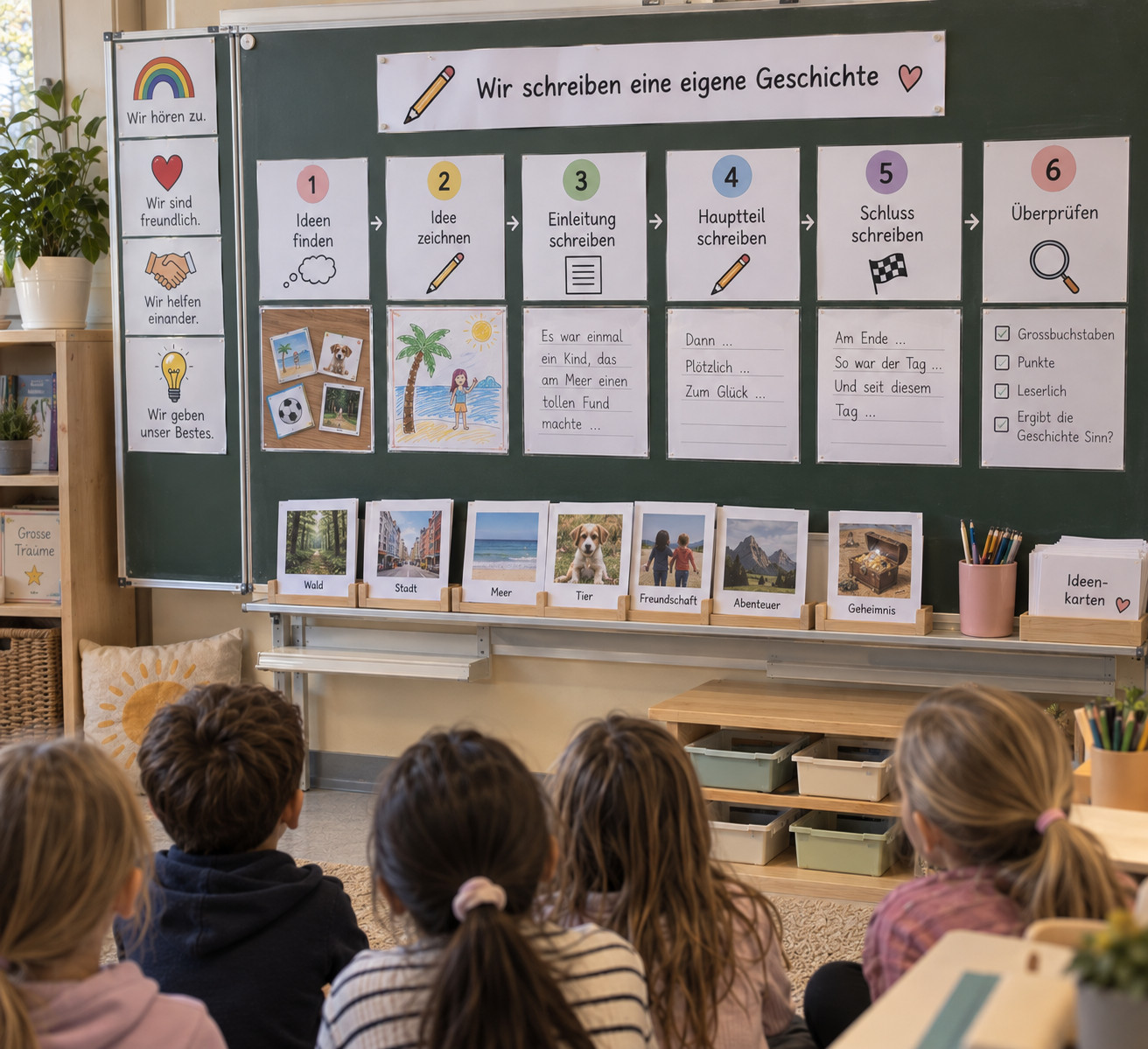
• Large tasks overload working memory. So break tasks into small, manageable steps and explain them one by one, accompanied by short, clear instructions and visual aids. A vague task thus becomes several clearly named small steps.
Example “We create an animal profile”:
1. Choose an animal (symbol magnifying glass)
2. Write three sentences (symbol pencil)
3. Draw a picture to go with it (symbol brush)
4. Write your name (symbol label)
5. Put it in the tray (symbol filing tray)
• Laminate the cards and fix them in a row on the board with a magnet or hook and loop tape. What is finished gets ticked off or turned over, so the progress stays visible.
• Example “Setting up your workspace” as a routine for the circle: lay out the pencil case, open the exercise book, clear away distractions, sit calmly. Four floor cards that the children place together in the correct order.
Making it visible and anchoring it
• Spoken instructions evaporate quickly. A short, visible sequence on the board relieves memory and makes the expectation clear for everyone. Capture the day’s structure visually and note interim results, so that the overview is kept and concentration goes to what matters.
Formats to print and laminate:
• Instruction cards in A6 format, one step per card, symbol large, one to three words. Laminated, with hook and loop tape or magnet.
• A sequence strip for the board: cards in a row with arrows between them.
• Floor cards A5 for the circle, to order the steps together.
• A checklist to tick off, laminated, writable with a water soluble pen and then wipeable, so reusable.
• Goal card always clearly set apart, for example with its own frame, so that goal and steps do not blur together.
Fixed routines
• Recurring sequences do not need to be explained again and memorised each time. They give security and free up working memory for the actual learning content.
Empirical evidence
• That a structured, clearly guided approach works is well established. In Hattie’s synthesis, direct instruction reaches an effect size of .59 and thus lies in the upper range of the strongest influences on learning success.
Practical tip
• Before saying an instruction, check it with the question: can it be said more briefly? Usually a third of the words fall away without losing content.
Pitfall
• Too high a pace undermines even the best structure. After each instruction, leave a short pause so that the child can process.

Material
Visualised daily structure. Step cards with numbered individual steps. Checklists for recurring routines. Agreed hand signals.
References
After: Selin Güler, primary school teacher and translationmanager at BeLEARN
Sources:
- Brunsting, M. (2011). Lernschwierigkeiten – Wie exekutive Funktionen helfen können. Grundlagen und Praxis für Pädagogik und Heilpädagogik (2nd, updated edition). Bern: Haupt Verlag (ISBN 978-3-258-07716-1). On working memory, cf. the chapter «Arbeitsspeicher» (p. 99 ff.), on self-regulation p. 110 ff. and 118.
- Sweller, J. (1988). Cognitive load during problem solving: Effects on learning. Cognitive Science, 12(2), 257–285. On the model of the three types of load, cf. Sweller, J., van Merriënboer, J. J. G. & Paas, F. (1998, updated 2019).
- Mayer, R. E. (2009). Multimedia Learning (2nd edition). Cambridge: Cambridge University Press.
- Hattie, J. (2009). Visible Learning: A synthesis of over 800 meta-analyses relating to achievement. London/New York: Routledge. There, direct instruction reaches an effect size of .59.
- SZH and CSPS (2024). Aufmerksamkeitsdefizitstörung mit oder ohne Hyperaktivität im Schulalltag. Bern. License CC BY-NC-SA 4.0. https://www.szh.ch
- Universität Bern, Gute Lehre: Direkte Instruktion. https://www.gutelehre.unibe.ch/lehrtipps/addaptive_lehre/direrkte_instruktion
- Brand, A. (2025). Direkte Instruktion ist mehr als nur Frontalunterricht. Deutsches Schulportal. https://deutsches-schulportal.de/bildungsforschung/direkte-instruktion-ist-mehr-als-nur-frontalunterricht/