Social Virtual Reality for Learning Languages by Collaborating in the Metaverse
In social Virtual Reality (SocialVR) people can meet, collaborate and thereby learn languages together in life-sized virtual environments.
Duration: February 2023 – Juli 2024
Status: Completed
Educational Level: Lower Secondary Level
Topic: Digital Tools
Keywords: Distance Learning, VR – Virtual Reality
Initial Situation
The ability to speak a second national language is essential for communication in this language. For this reason, efforts have been made for some time to enable people with different mother tongues to practice speaking in a second national language together. In such a “language tandem”, they speak in the language that is the mother tongue of the other person and can thus receive continuous feedback on their own speaking. However, language tandems involve overcoming physical distances, which incurs time and financial costs. To save time and money, video telephony has also been used in recent years. However, this means of communication lacks a shared space in which communication can be facilitated naturally through pointing or interactive actions. In addition, video telephony often leads to exhaustion (so-called “zoom fatigue”), which can be attributed to unnatural communication. An alternative is social virtual reality (VR), which can be viewed and visited together using VR glasses that are connected to each other via the internet. In this SocialVR, people can meet in life-sized, three-dimensional everyday situations and communicate with each other both verbally and non-verbally. SocialVR can therefore be used to practice speaking the language of the other person directly and naturally in the midst of an interactive everyday situation, despite physical distance. Thereby, SocialVR may serve to learn speaking foreign languages very effectively and efficiently.
Objectives
The goals of this project were to develop a SocialVR that can serve for the tandem learning of French and German in the school context and to investigate if teachers regard this learning system to be useful for this purpose.
Method
First, an interactive task and situation that can serve for tandem language learning within SocialVR was determined in close collaboration with experts for language learning. Second, this learning task and situation was integrated into a SocialVR environment. Third, the resulting SocialVR learning system was tested and rated by teachers.
Results
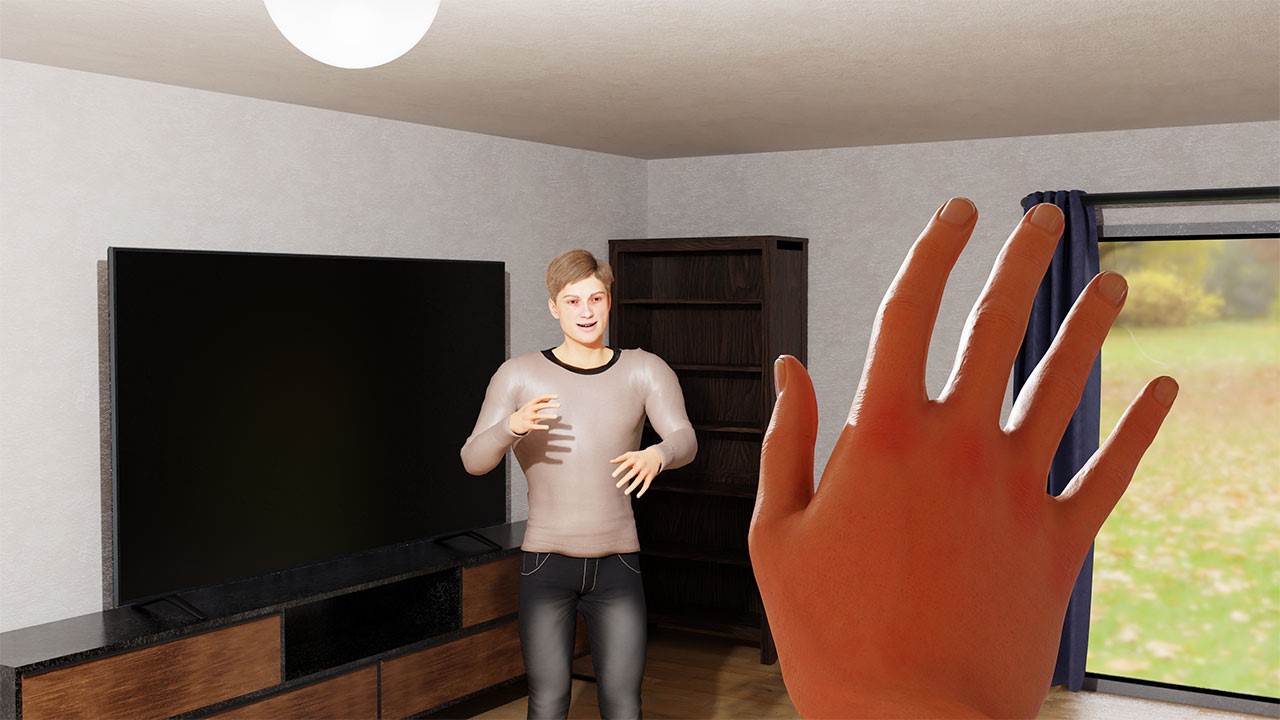
We have developed a SocialVR consisting of a virtual apartment that can be visited and furnished together using VR glasses connected to the internet. Whereby, the furnishing of the apartment together is serving to practice talking to each other verbally. The teachers testing our SocialVR rated it as immersive, engaging as well as useful for learning to speak German and French.
Implemented Translation
Based on our findings we have conceived a workshop on using our SocialVR together with pupils, which we gave and keep offering and giving for both active and preservice teachers. Using our SocialVR for tandem language learning over distance can foster speaking skills as well as intercultural skills in a way that adds a valuable component to existing teaching methods. Thereby, our SocialVR has the potential to promote multilingualism in Switzerland by helping to establish the necessary language skills in young people using an innovative digital technology. Finally, it should also be mentioned that learning how to use SocialVR technologies themselves, which are likely to play a role in future work life supports the development of basic skills in information and communication technologies.


