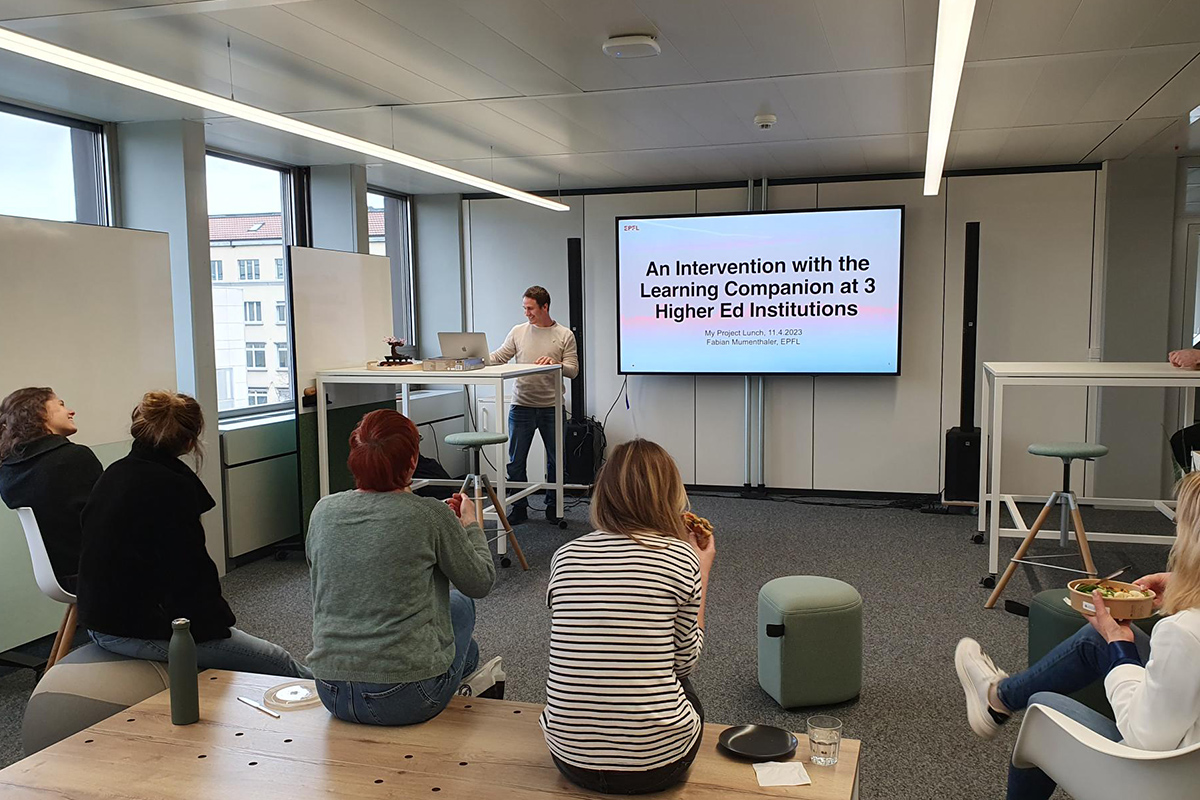
An Intervention with the Learning Companion
With the Learning Companion, we aim to help future students acquire efficient study habits and metacognitive skills which are important for lifelong learning.
Duration: July 2023 – December 2024
Status: Completed
Educational Level: Tertiary Level
Topic: Artificial Intelligence AI, Digital Skills & Literacy, Digital Tools
Keywords: Digital Skills, Effective Learning Habits, Metacognition
Initial Situation
Many students at the tertiary level lack awareness of effective metacognitive learning strategies, which are essential for academic success and lifelong learning. Although research confirms that metacognitively aware students tend to perform better, metacognitive skills such as planning, monitoring, and evaluating one’s own learning are rarely taught explicitly. To address this, EPFL developed the Learning Companion tool, which helps students assess and improve their study habits and problem-solving strategies. The tool provides feedback and suggests online learning resources based on self-assessment. Building on this tool, the project introduced targeted interventions at EPFL, PHBern, and BFH to explore how fostering metacognitive reflection—especially through chatbot interaction—can improve learning outcomes. With the rapid rise of AI and large language models in 2023, the intervention was adapted to include a chatbot that engages students in reflective conversations about their preparation for classes and exams. The chatbot aimed to simulate a coaching dialogue, helping students articulate their study strategies, identify obstacles, and adopt more effective learning techniques, while prioritizing data privacy and psychological safety.
Previous Project
In the previous Learning Companion project, the Learning Companion, which had previously been available only in English and French, was translated into German and validated with students at PHBern. In this process, differences in learning habits and self-regulation between different groups of students were also investigated.
Objectives
The project aimed to test whether chatbot-guided metacognitive reflection improves students’ learning strategies and preparation more effectively than traditional practice. It also investigated whether self-reported measures like self-regulated learning (SRL) and academic self-efficacy predict student engagement with the chatbot.
Method
The project explored how students reflect on their learning strategies using the Learning Companion (LC). Lecturers suggested flexible reflection tasks suitable for any course type. Students’ self-regulation skills—such as planning, monitoring, evaluation, and time management—were assessed via LC questionnaires. Their digital competencies were measured using selected scales from the DigiCompEdu questionnaire. A chatbot guided students through structured reflection tasks, supporting metacognitive processes without teaching course content. Three studies tested how students engaged with these tools and whether stronger self-regulation predicted greater chatbot use.
Results
In three studies, the research team examined how a chatbot supports students in reflecting on their learning strategies and exam preparation. In Study 1, only a few students used the chatbot, so no clear link between self-regulation and chatbot use was found. Study 2 suggested that students with higher self-regulation skills were more likely to engage with the chatbot. Study 3 improved the instructions and task order, showing that the chatbot could systematically identify students’ preparation levels, study techniques, and learning obstacles, and offer personalized recommendations. Despite this, results showed that self-reported regulation skills did not reliably predict how actively students used the chatbot. Overall, the studies demonstrated that chatbots can effectively guide reflection and planning, helping students become more aware of their learning strategies.
Implemented Translation
The project team integrated research-based coaching strategies directly into the chatbot, enabling students to reflect on their learning in a structured way. The chatbot encouraged articulation of study techniques and obstacles, and provided personalized suggestions based on students’ input. It was designed to stay within a coaching role and avoid content teaching, promoting safe and ethical use of AI in education. Technical deployment was secured through Swiss-based infrastructure, ensuring compliance with data protection standards. The intervention was tested at three partner institutions and offers potential for future integration into learning support practices.
The project demonstrated that a well-designed chatbot can facilitate meaningful metacognitive reflection and support students in adopting effective study strategies. It showed that such tools can complement traditional educational approaches, even if individual characteristics like SRL do not predict engagement. The chatbot’s integration into institutional support systems marks a step forward in translating learning science into practice, especially in light of increasing interest in AI-supported education. The insights gained will inform future iterations of the Learning Companion and broader digital learning tools.
Link to the “Learning Companion” tool