Who was it? Moving and yet learning to brake
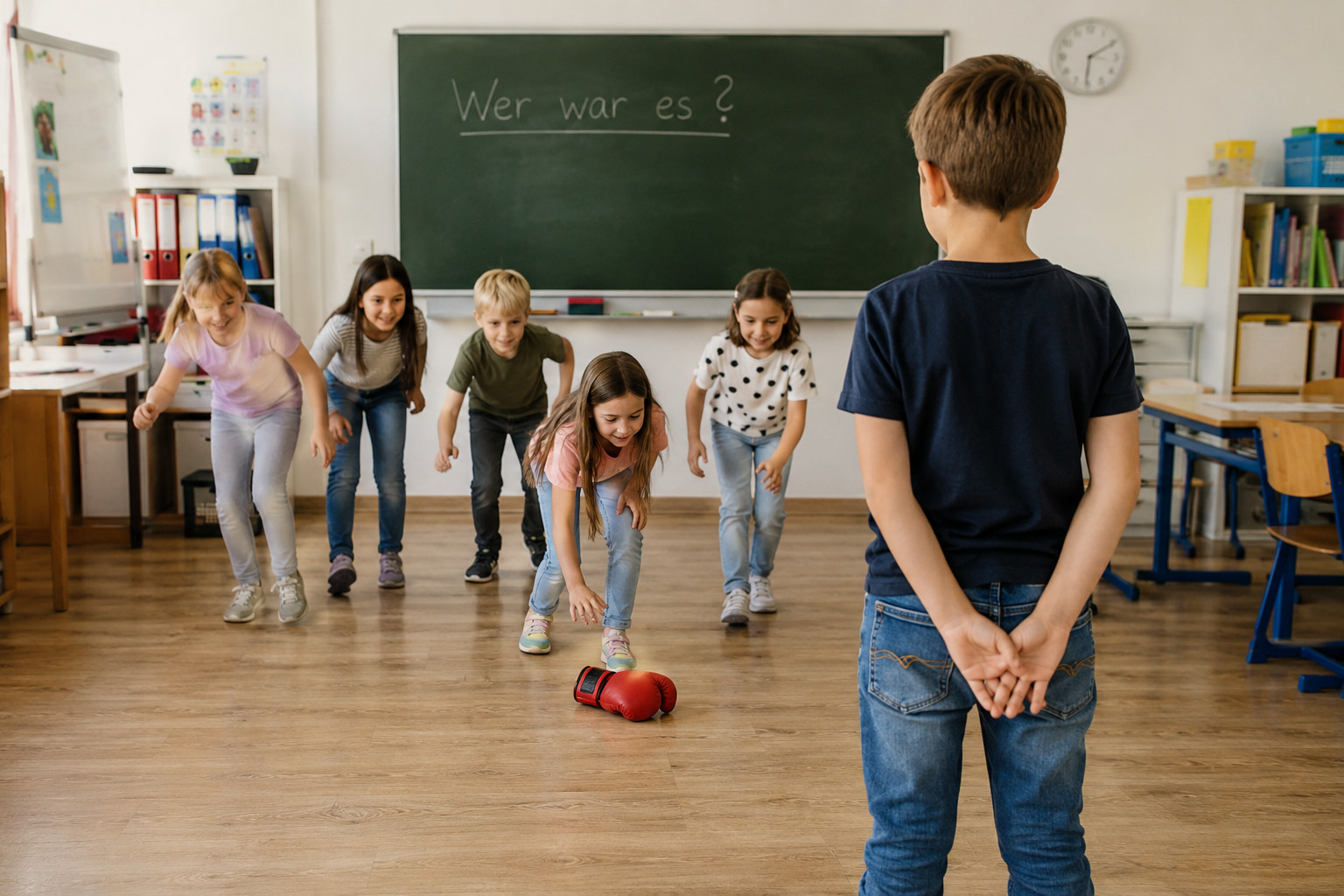
One child stands with their back to the class and guards an object, for example a boxing glove, that the others want to touch quietly. As they turn around, the front child has two to three guesses to work out who touched it, while the class cooperates without a word and blocks the view. The game gives the urge to move an outlet and at the same time trains impulse control, planning and cooperation.
Key Information
Subject/ Subject Area: Cross curricular / Self regulation and cooperation
School Level: Cycle 1 and 2
Implementation
The principle
One child guards an object with their back to the class. The others want to touch it unnoticed and without giving themselves away when the child turns around. It is not speed that counts, but quiet action, a straight face and clever teamwork.
How the basic form runs
The front child stands with their back to the class, the glove lies on the floor behind them. On a quiet signal, the class starts to move. One child touches the glove, the others move too so that it is not obvious who it was. Then the front child turns around and everyone stands still. They have two to three guesses to name who touched it. On a correct guess the role changes, otherwise a new round begins.
The silent strategy
The appeal lies in the wordless teamwork. Children who are near the glove can position themselves so that, as the front child turns, they block the view of the person who touched it. The class learns to cooperate without arranging anything, to read glances and to hide their own reaction. It is exactly this shared, silent planning that makes the exercise valuable.
Why it works
Creeping up quietly and not giving away one’s role trains impulse control, which the technical term calls inhibition, because anyone who fidgets, giggles or rushes gets spotted. At the same time the game draws on working memory and planning, since the class remembers positions and thinks ahead, and it practises cooperation and putting oneself in the front child’s view. Because movement is allowed and an exciting goal beckons, children with a strong urge to move stay well engaged, without being singled out.
The bridge to the real moment
The core can be named calmly afterwards: the calm face and the holding back the class used is the same control that helps in everyday life, when something threatens to slip out. This way the children link the game to everyday life.
The pitfalls
Make sure it is not always the same children who get to touch, otherwise the calmer ones get bored and the fastest dominate. Keep the guessing phase short and clear at two or three tries, so the front child is not put under pressure. And if blocking the view turns into jostling, make a short break and recall the principle: screen with the body, without touching.
Materials
A clearly visible object as the target, for example a boxing glove. Enough space for the class to move freely, optionally a chair at the front.
References
After: Selin Güler, primary school teacher and translation manager at BeLEARN