Class Council
The class council is much more than an organizational framework. It doesn’t just discuss democracy - it makes it tangible. Children learn that their voice matters and that solutions found together are more sustainable than top-down rules. Those who take part in decisions take responsibility.
Key Informaiton
Subjecct/ Subject Area: Nature, Humans, Society (NMG), Organization / Classroom Management
School Level(s): Cycle 1 and 2
Implementation
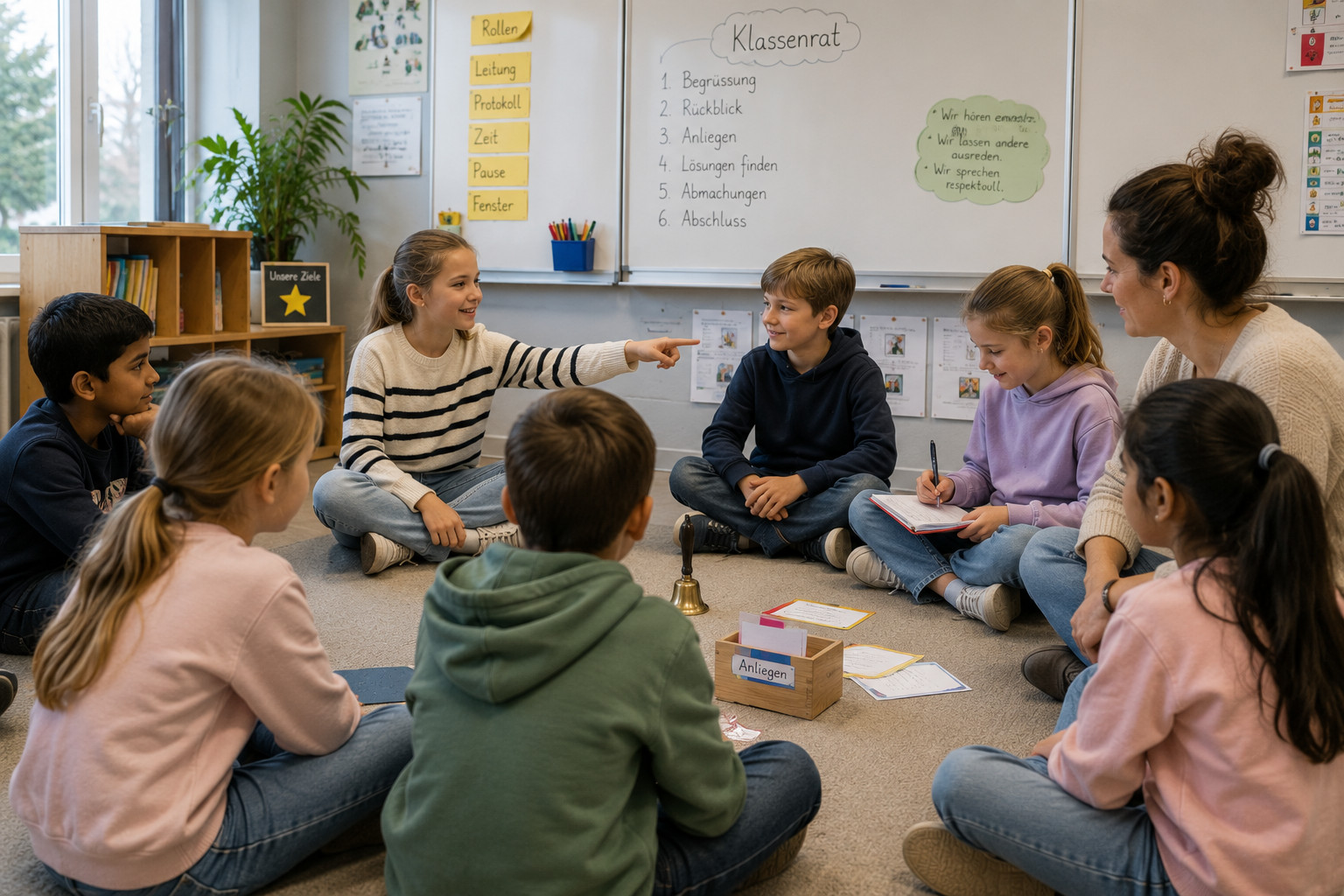
The class council is much more than an organizational framework. It is one of the most effective ways to make democracy tangible. Children learn that their voice matters, that conflicts can be discussed without escalation, and that solutions found together are more sustainable than top-down rules. When students are involved in creating a rule, they identify with it and are more likely to follow it – this is not wishful thinking but a well-documented finding from motivational psychology.
In practice, a fixed rhythm works best: once a week, for 20 to 30 minutes, always at the same time. Children can submit topics in advance, for example on a note in a suggestion box or digitally, which also gives quieter children a voice who may find it harder to speak up.
During the class council, children take on specific roles, such as:
- The chairperson leads through the agenda and gives the floor to others. They may have an assistant.
- The recorder notes what was discussed and decided, either by hand in the class council book or on a laptop.
- The timekeeper monitors the time and signals when an item takes too long.
- The break monitor keeps an eye on recess organization or open issues related to breaks.
- The window monitor ensures the room is aired before the meeting and that the atmosphere is pleasant.
These roles rotate so that all children take on different responsibilities and develop various skills: listening, structured speaking, note-taking, moderating, and taking responsibility. The teacher supports but only intervenes when necessary.
It is important that the class council remains solution-oriented: What do we wish for? What can we change together? Within the same framework, children can also learn to give each other targeted feedback. At the beginning of the week, each child draws a slip with the name of a classmate to observe closely. At the end of the week, during the class council, each child gives feedback to the person they drew: What did I notice about you? What went well? What should continue? Over time, this builds a class community that supports, strengthens, and sustains itself.
Materials
Class council notebook or digital record, suggestion box, role cards, timer
References:
After: Selin Güler, primary school teacher and translation manager at BeLEARN
Sources: Blum, E. & Blum, H.-J. (2023). Der Klassenrat. Ziele, Vorteile, Organisation. Verlag an der Ruhr.