Ethical Thinking – SEEL and Ethics
SEE Learning promotes ethically responsible decision-making processes as part of a compassion-based attitude. In the SEEL approach, children learn that complex questions do not need simple answers – and that thinking about them together is already an important competency.
Key Information
Subject/ Subject Area: Nature, Humans, Society (NMG), applicable across subjects
School level(s): Cycle 1 and 2
Implementation
SEE Learning promotes ethically responsible decision-making processes as part of a compassion-based attitude. In the SEEL approach, children learn that complex questions do not need simple answers – and that thinking about them together is already an important competency.
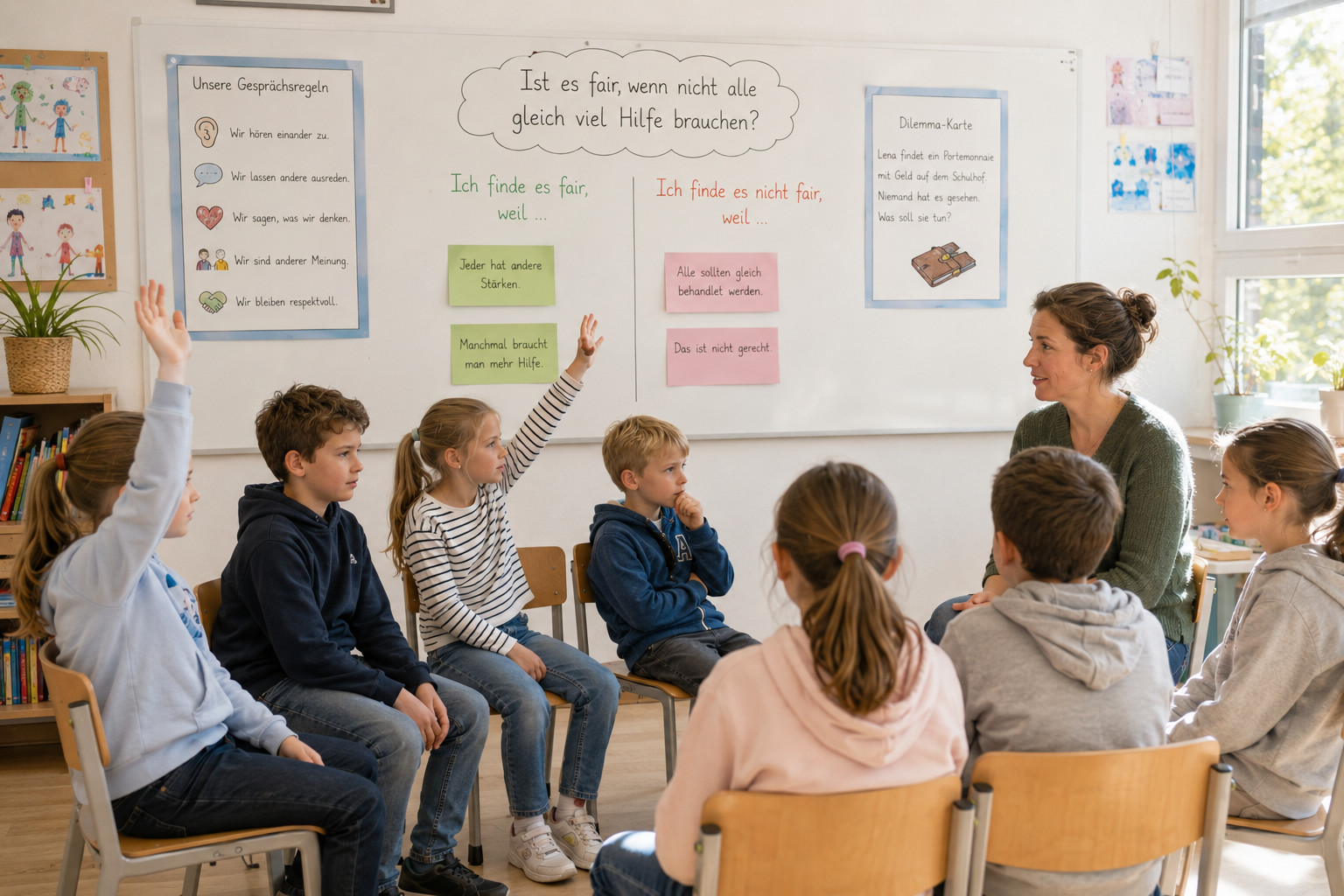
A class discussion like ‘Is it fair if not everyone needs the same amount of help?’ opens the space for ethical thinking. These moments lay the foundation for self-regulated learning, because children learn to tolerate conflicts and to search for solutions together.
Concrete ideas for everyday school life
• Dilemma cards: Short stories with an ethical dilemma, for example ‘Lena finds a wallet with money. What does she do?’ Children discuss in small groups.
• Voting rituals: ‘Who finds that fair? Who doesn’t?’ Children raise their hands or stand up, then the arguments are discussed.
• Class discussion with conversation rules: Let people finish, listen, be allowed to disagree.
• Philosophising with children: With the ’52 Picture Cards’ (Orell Füssli) as a low-threshold entry.
Picture books as conversation starters
• ‘Zwei für mich, einer für dich’ (Cycle 1 and early Cycle 2): How can two animals share three mushrooms? The book invites children to think about justice and equality – ideal for Cycle 1 and early Cycle 2.
• ‘Voll ungerecht! Über Fairness und Gerechtigkeit’ by Assata Frauhammer (Beltz, 2024): Links everyday school and family situations with philosophical questions about fairness and justice, particularly suitable for Cycle 2.

Material
Mühle, Jörg (2018): Zwei für mich, einer für dich. Moritz Verlag. Bilderbuch.
Frauhammer, Assata (2024): Voll ungerecht! Über Fairness und Gerechtigkeit. Beltz Verlag. Bilderbuch.
References
After: Selin Güler, primary school teacher and translationmanager at BeLEARN