Remembering through storytelling: the story journey
The story journey uses the method of loci for telling. Fixed places in the room become settings where a story is created or retold station by station. The aim is twofold: the fixed spatial order supports retention, the thread is not lost, and free formulation at each station develops vocabulary, sentence structure and the shape of a story. This way the exercise links memory and language development, and for children with a strong urge to move, telling runs through walking rather than sitting still.
Key Information
Subject/ Subject Area: Language / language, storytelling and learning strategies
School Level: Cycle 1 and 2
Implementation
The principle
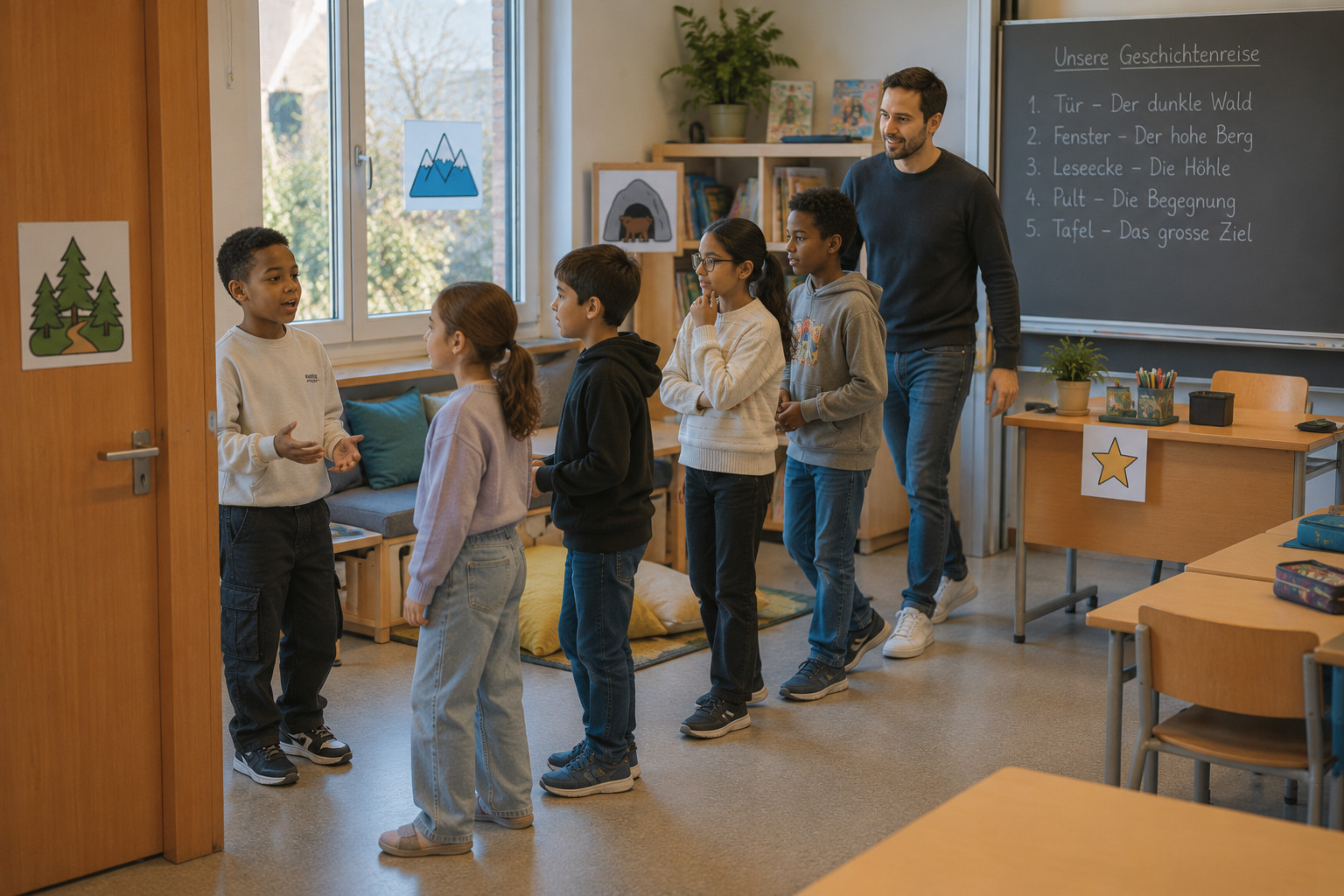
Fixed places in the room become the settings of a story, always in the same order. Each step of the plot is tied to a place and linked there to a vivid image. Telling happens while walking, from station to station. Because the space holds the thread, the children do not lose it as they tell.
How the basic form runs
First a fixed route with four to five places is set together, for example door, window, reading corner, desk, board. Each place becomes a setting: the door the dark forest, the window the high mountain, the reading corner the cave. Then the story travels through the stations: it begins at the door, continues at the window, ends at the board. The class walks the route and tells the next part at each station. At the end, the whole story can be retold freely, because each step hangs at its place.
Three ways to use it
Retelling: a story read or heard is distributed across the places, then retold at the stations. This way the sequence stays firmly in mind. Inventing: the class invents a story together, station by station. At each place a child adds the next part, the others build on it. Writing scaffold: before writing, the children walk their story at the places. The structure is set before the first sentence, and the thread holds in writing too.
What it trains twice over
For memory, the fixed order of places carries the thread, the child does not lose it, because the space holds it. For language, at each station children formulate freely, embellish and continue. This practises vocabulary, sentence structure and, in passing, the shape of a story, beginning, middle, turning point and end. This way the exercise links retention to narrative skill.
How to deepen it
A personal story route along one’s own way to school, which each child carries everywhere. A silent variant where the journey is walked only in the head, which shifts the support inward. Or the children design their settings themselves, with a small drawing or a symbol at the place, which anchors the images even more.
The gentle frame
The story journey is a shared game, not a presentation in front of the class. Practise together first, so that everyone understands the technique. For children who quickly lose the thread, the fixed order of places replaces what their own memory does not provide, which gives security rather than exposing. Let each child choose their own images, because personal images stick and tell more easily.
The pitfalls
Too many stations overwhelm, four to five are enough for a rounded story. The route must stay stable, if the order changes, the thread breaks. And do not push for completeness, free embellishment is worth more than word-for-word reproduction.

References
After: Selin Güler, primary school teacher and Translation Manager at BeLEARN
Sources: method of loci. Origin: Rhetorica ad Herennium (c. 86 to 82 BC).
Effectiveness: Dresler, M. et al. (2017). Mnemonic Training Reshapes Brain Networks to Support Superior Memory. Neuron, 93(5), 1227 to 1235.