Clearly structured learning materials new
Worksheets, learning tasks and assessments follow a consistent layout. The aim is to help pupils spend less attention finding their way around a page and more attention on the learning task itself.
Key information
Subject/ Subject area: Cross-curricular
School level(s): Cycle 1 and 2
Curriculum link: Cross-curricular competencies: personal competencies (self-reflection and independence), methodological competencies (learning strategies, planning and structuring tasks), and independently observing and assessing one’s own learning progress.
Focus: Memory, Distraction, Daydreaming

Implementation
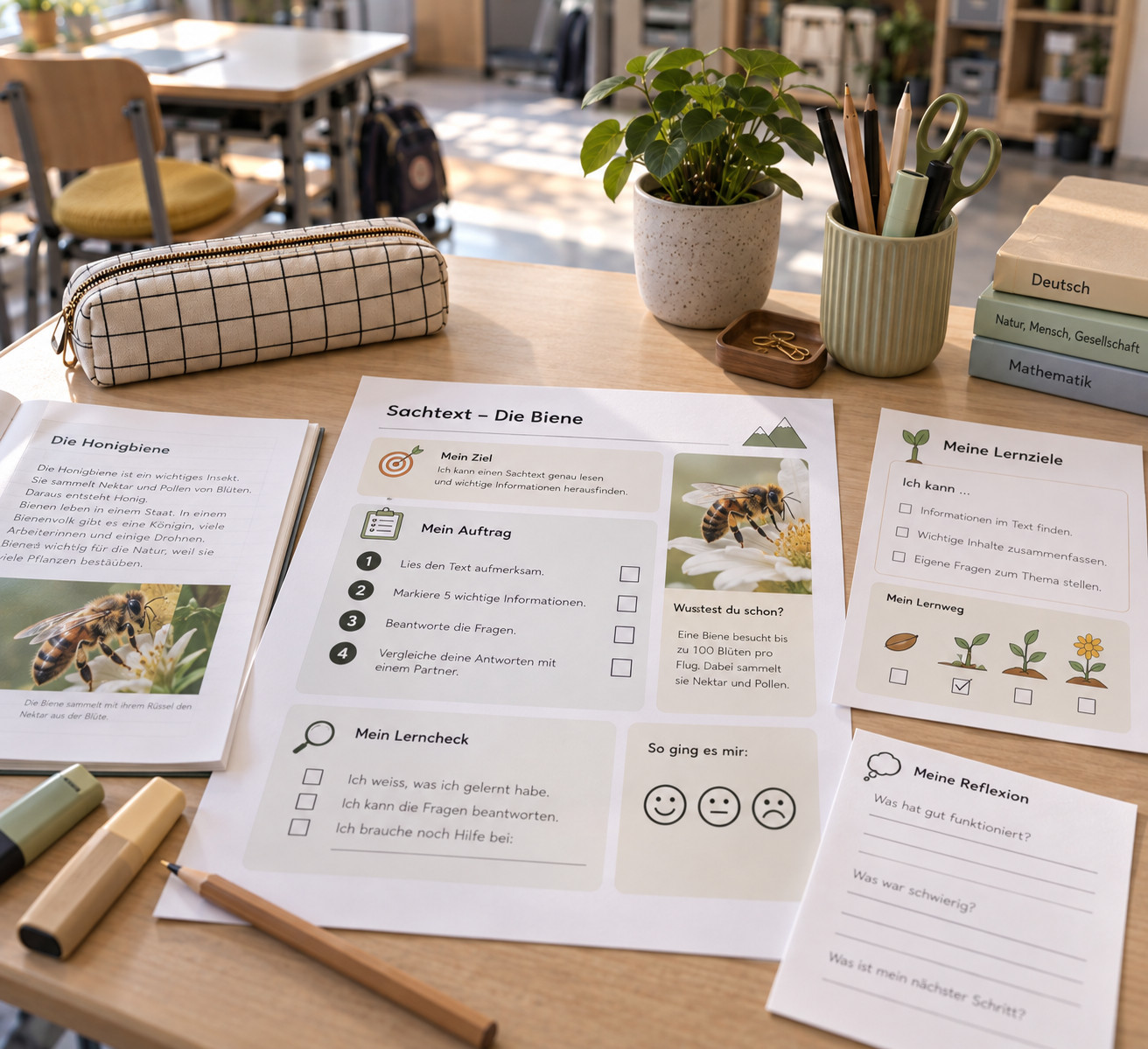
Use a consistent basic layout. Wherever possible, structure worksheets, learning tasks and assessments in the same way: topic → learning goal → task → steps → check → reflection. Keep recurring elements in the same place so that pupils do not have to work out how to navigate each new resource.
Break tasks into steps. Divide longer tasks into short, numbered steps. Small checkboxes show what has been completed and what comes next. Where possible, give just one main instruction per step.
Keep the design uncluttered. Leave enough white space and highlight important information selectively. Use colours, borders, images and symbols only when they serve a purpose. A few recurring symbols are enough, for example, for learning goals, tasks, checks and reflection.
Make learning goals visible. Use child-friendly language to describe what pupils should learn or demonstrate, for example: “I can explain three features of a fable.” The goal can appear in the same format on worksheets, assessments and goal cards.
Make learning progress visible. A simple system can show pupils where they are in their learning. For example, a plant grows as learning progresses:
• Seed: I am starting.
• Seedling: I can do it with help.
• Plant: I can do it independently.
• Flower: I can explain and apply it.
• These stages show development; they are not a judgement of the child.
Use consistent reflection questions. Rather than creating new reflection tasks each time, use a few recurring questions: What can I already do? Where do I still need help? What is my next step? Younger children can also use the plant stages to assess their progress.
Use a classroom poster. Display the same structure in the classroom: What is my goal? → What do I need to do? → How can I check my work? → What is my next step? Pupils then encounter the same language on worksheets, on the board and in classroom discussions.
Use goal cards. Individual goal cards can include a learning goal, suitable strategies and a brief self-assessment. Updating them regularly makes progress visible over time.
Keep progress meetings in mind. Collect selected goal cards, examples of pupils’ work and brief self-assessments. During progress meetings, pupils can use these concrete examples to show what they can already do, which strategies help them and what they would like to work on next.
Adapt existing materials instead of creating new ones. A few changes are often enough: add a learning goal, shorten the instructions, number the steps, remove unnecessary design elements and include a brief learning check. This allows existing materials to become more consistent gradually and with little extra effort.
Use the structure with everyone. Introduce it for the whole class rather than assigning it to individual pupils. This creates a familiar learning environment that can benefit pupils with different needs.
Practical tip: Start by creating one worksheet template and one assessment template, then choose three to five recurring symbols. The more consistently the structure is used across materials and subjects, the more familiar it becomes to pupils.
Potential pitfall: A structured layout does not mean adding as many colours, boxes and symbols as possible. Too many visual elements can themselves be distracting. Everything on the page should have a clear purpose.


Material
Existing worksheets, learning tasks and assessments; optionally, consistent templates, goal cards, reflection cards and a classroom poster with recurring symbols.
References
After: Selin Güler, primary school teacher and translationmanager at BeLEARN
Sources:
- Brunsting, M. (2011). Lernschwierigkeiten – Wie exekutive Funktionen helfen können. Grundlagen und Praxis für Pädagogik und Heilpädagogik (2., aktualisierte Auflage). Bern: Haupt Verlag. Wie eine vertraute, wiederkehrende Struktur das Arbeitsgedächtnis entlastet.
- Helmke, A. (2022). Unterrichtsqualität und Professionalisierung. Diagnostik von Lehr-Lern-Prozessen und evidenzbasierte Unterrichtsentwicklung. Hannover: Klett Kallmeyer. Klarheit und Strukturiertheit als Merkmal guten Unterrichts, Grundlage für ein einheitliches, wiederkehrendes Grundlayout.