Affirmation Quick Implementation
Inner attitude influences how children experience and cope with performance situations. Those who learn to strengthen themselves develop a resource that has an effect far beyond school. Affirmation cards are a simple, low-threshold tool to anchor exactly this in everyday life.
Key Information
Subject/ Subject Area: Nature, Humans, Society (NMG), applicable across subjects
School Level(s): Cycle 1 and 2
Implementation
Particularly in performance situations such as assessments, a child’s inner attitude can decide whether they show their abilities or are blocked. Affirmations are short, positive belief statements that help interrupt negative thought patterns and strengthen confidence in one’s own abilities. They do not work as magic but as an anchor: a child who calls a strengthening sentence to mind just before the test approaches the task more calmly and confidently.
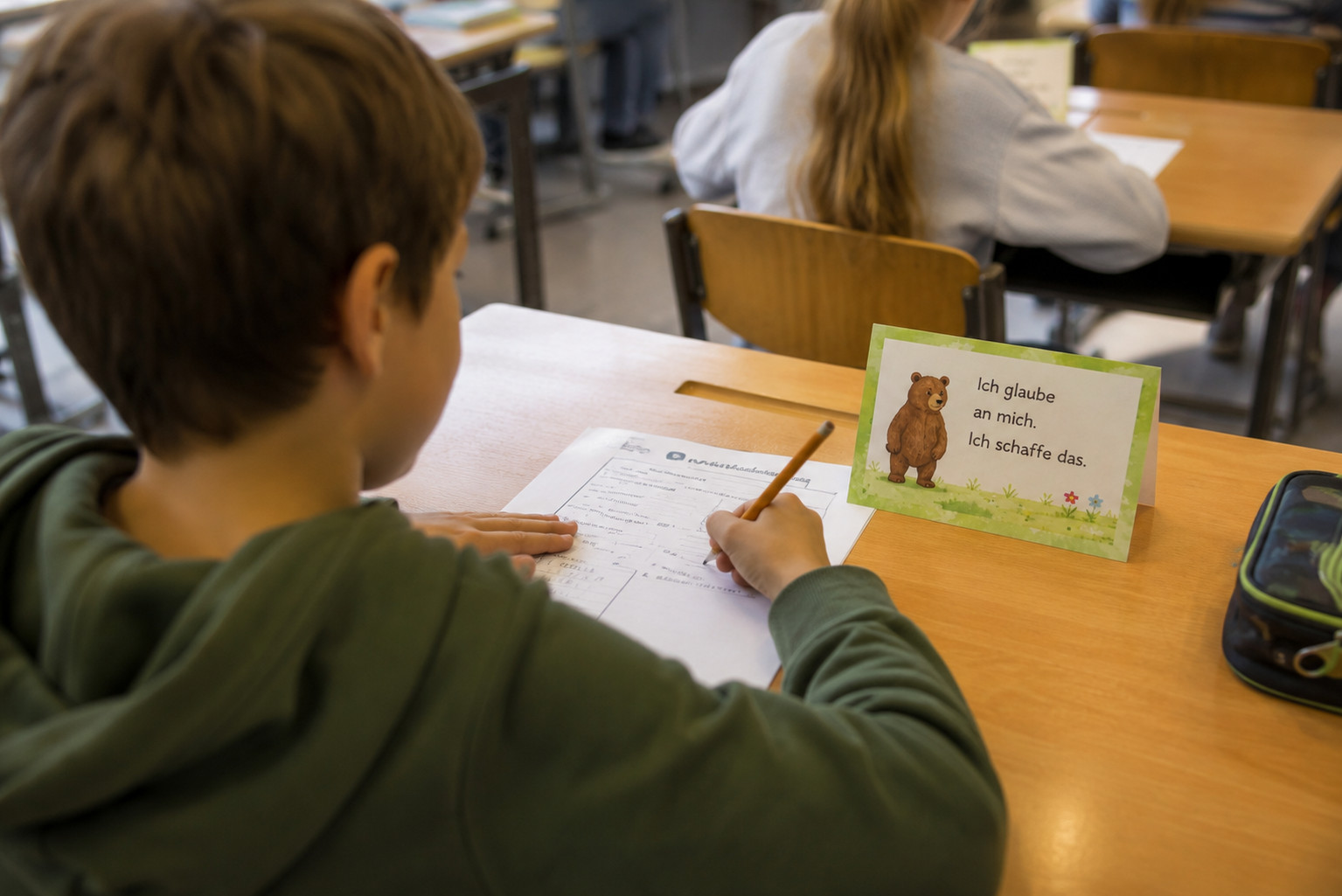
Affirmation cards can be integrated easily into everyday school life – in the morning as a short ritual, before assessments as an individual card on the desk, or as a fixed component of self-strengthening at the end of the week.
Concrete Ideas:
- Before an assessment, each child draws an affirmation card. The card remains visible on the desk during the test.
- Morning ritual: Every day, one child draws a card for the class and reads it aloud. The card hangs on the board all day.
- Children design their own affirmation cards with a personal sentence and a drawing. These go in the pencil case or the snack box (Znünibox).
- The teacher places a card on each desk before a difficult lesson, without explanation, as a silent gesture of encouragement
Recommended material
- ‘Bärenstarke Gedanken für Kinder’ by Saskia Baisch-Zimmer (Beltz Verlag): 32 affirmation cards with bear illustrations.
Material
‘Bärenstarke Gedanken für Kinder’ by Saskia Baisch-Zimmer (Beltz Verlag): 32 affirmation cards with bear illustrations.
References
After: Selin Güler, primary school teacher and translation manager at BeLEARN