Thinking Aloud
Thinking aloud begins with a question. When philosophising with children, a space is created in which there are no wrong answers, only different perspectives worth exploring.
Key Information
Subject/ Subject Area: Nature, Humans, Society (NMG), applicable across subjects
School Level(s): Cycle 1 and 2
Implementation
A safe learning space is not created by a one-off measure, but by consistent, everyday signals: how teachers respond to mistakes, whether children experience their contributions being taken seriously, and whether uncertainty is made visible as a normal part of learning. This also means reflecting on one’s own attitude. Teachers who name their own uncertainties or admit mistakes model exactly the behaviour they wish for from their students.
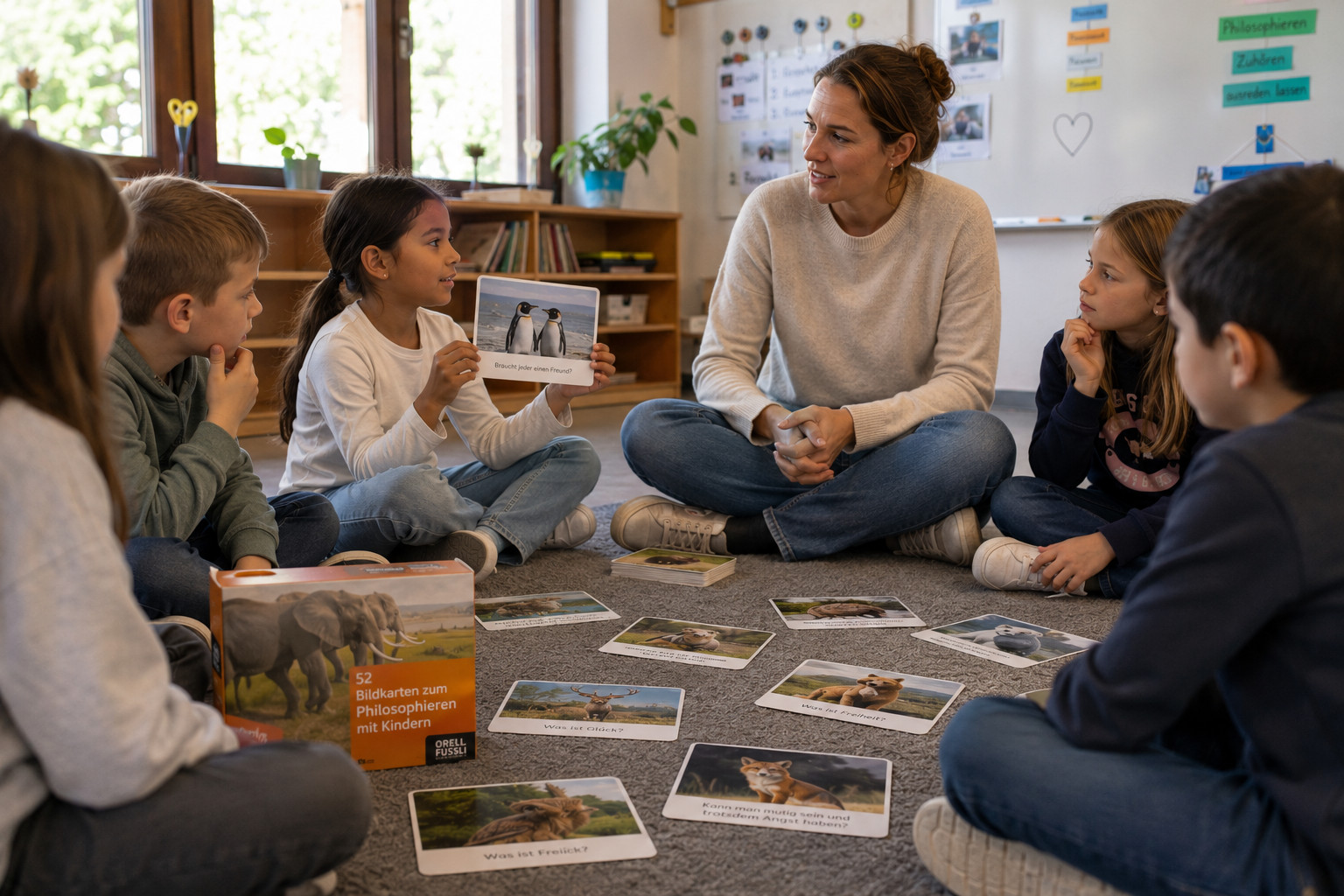
In everyday school life this can take many forms: a class charter developed together at the beginning of the school year, regular reflection rounds or targeted conversation rituals. A particularly low-threshold method is philosophising with children. In open conversation rounds on questions such as ‘What does freedom mean?’ or ‘Does happiness exist?’, children concretely experience that there are no wrong answers, only different perspectives worth exploring. Cross-curricular competencies such as listening, being patient and tolerating criticism are learned alongside philosophising. This creates a conversational culture in which children dare to think aloud, even when they are uncertain. Particularly recommended are the ’52 Picture Cards for Philosophising with Children’ (Orell Füssli): the cards address everyday questions, require no prior knowledge and can be flexibly integrated into circle discussions or the morning circle.
Practical examples
- Developing the class charter together: At the beginning of the school year, children and teacher establish together how they want to treat each other. What applies with us when someone makes a mistake? What do we do when someone is laughed at? The charter hangs visibly in the room.
- Mistake-of-the-day moment: The teacher briefly tells of their own mistake, for example a wrongly calculated task or forgotten material. No drama, just normal. This lowers the threshold for everyone.
- Friday reflection round: Five minutes at the end of the week: What was difficult? What didn’t I understand today? What do I want to do better next week? Anonymously on slips of paper or aloud in the circle.
- Philosophy circle with picture cards: A card from the ’52 Picture Cards for Philosophising with Children’ is placed in the centre. The teacher poses the question, waits and holds out. No evaluation, no ‘exactly right’, only follow-up questions: ‘What do you mean by that?’ or ‘Does someone see this differently?’
- Making uncertainty visible: A small corner on the board or a Post-it area with the title ‘What I haven’t understood yet’. Children anonymously stick their open questions on it. The teacher picks them up without naming names.
- Ritualising conversation rules: Before each discussion round, the same three rules are introduced: I listen until someone has finished. I am allowed to disagree. I address ideas, not people. Over time, no reminder is needed.
Material
“52 Picture Cards for Philosophising with Children” by Kristina Calvert
References
After: Selin Güler, primary school teacher and Translationmanager at BeLEARN