Relationship Buildung
According to John Hattie, the relationship between teacher and students is one of the strongest influences on academic achievement – more effective than class size, homework or open learning formats.
Key Information
Subject/ Subject Area: Cross curricular, Organization / Classroom Management
School Level: Cycle 1 and 2
Implementation
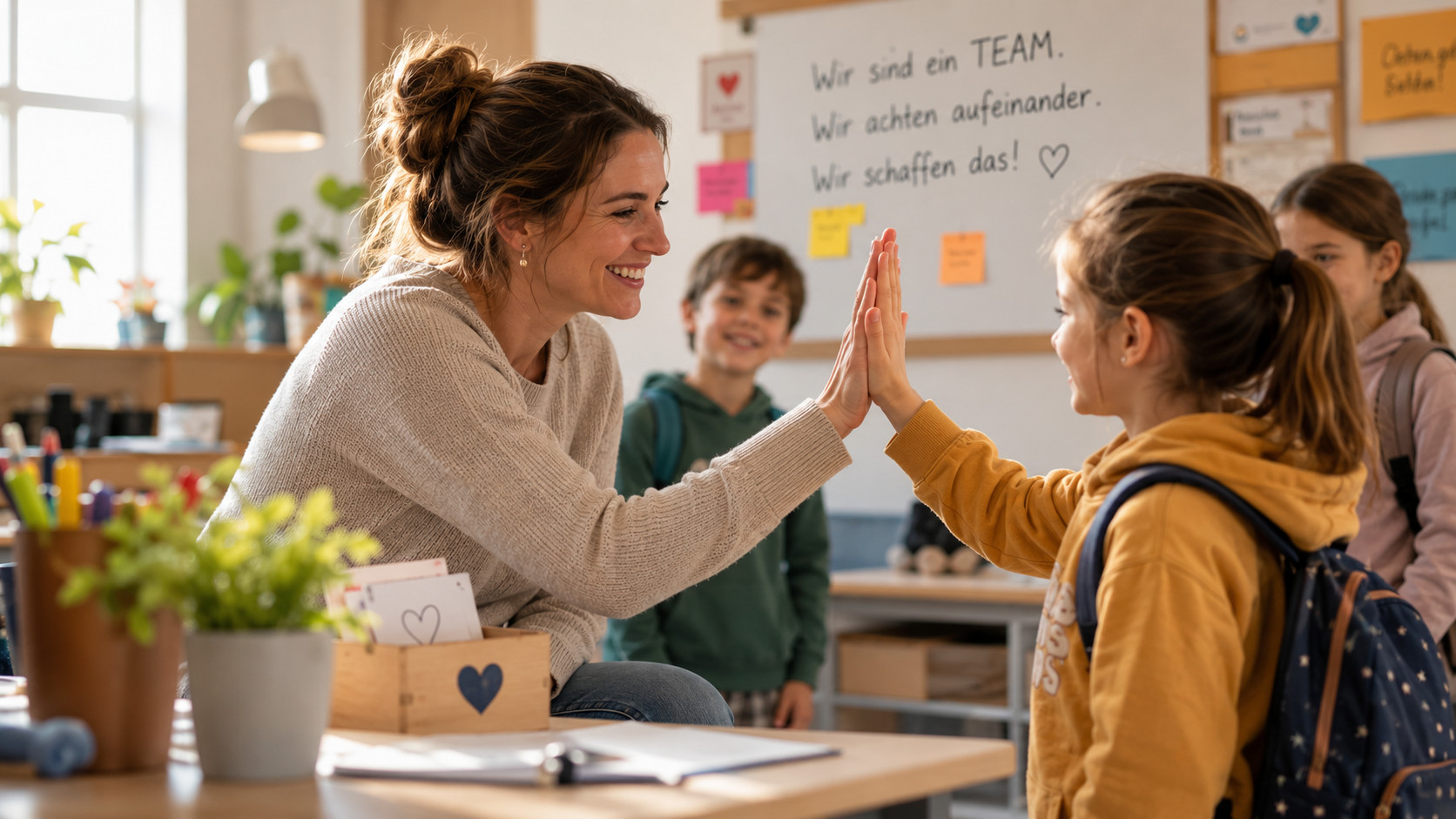
The teacher-student relationship counts, according to John Hattie’s latest evaluation (Visible Learning, 2023), among the strongest influences on academic achievement, clearly more effective than for example class size, homework or open learning formats. Yet relationship building does not require long individual conversations. In everyday life this means: a personal greeting at the door, a brief ‘Everything okay?’ in passing, a handwritten note in the exercise book, or a class letterbox in which children can anonymously drop in their concerns.
Relationship building also happens between the children. Cooperative learning formats such as partner work, group tasks with distributed roles or shared projects strengthen the sense of togetherness, because children experience that they achieve more together than alone. Simple rituals also help: a weekly compliment or an anonymous thank-you note in a box durably strengthens the sense of community. Particularly for children who are more on the social periphery, targeted tandems or fixed group roles can be an important bridge.
Implementation ideas
- Greeting ritual with choice: Each child chooses at the beginning of the year their personal greeting style – handshake, high five, fist bump, elbow greeting, pirouette or simply a nod. The teacher greets each child in their own way every morning. It takes seconds, but each child knows: I am expected.
- The hot seat (positive): A child sits on a special chair and the class says something nice one after another. It sounds simple but often stays in the memory for a long time.
- Secret mission of the day: The teacher whispers a small secret mission to a child when entering, for example ‘Your mission today: make someone laugh.’ Brief report at the end of the day.
- Planning shared laughter: A short joke, a funny picture or a brief guessing game at the start of the lesson creates a relaxed atmosphere and connects.
- Planning break conversations deliberately: Each week the teacher plans to briefly chat with one or two children at break time – not about school, but about hobbies, favourite animals or what they did at the weekend.
- Mistake-of-the-day award: The teacher tells of their own mistake or an embarrassing situation. This shows that mistakes are human and lowers the threshold for everyone.
- Class language: The class invents together a word or an in-joke that only applies in this class. A word for ‘we can do it’ or a cheer after a successfully completed task.
Material
Class letterbox: a box or envelope, slips and pens. Thank-you note box: a box or envelope, slips and pens. The hot seat: a special chair or blanket that turns the chair into a place of honour. Secret mission: optionally a small card or slip with the mission.
References:
After: Selin Güler, Primary School Teacher and Translationsmanager bei BeLEARN
Source: Hattie, J. (2024). Visible Learning 2.0. German-language edition of ‘Visible Learning: The Sequel’, translated by S. Wernke & K. Zierer. Schneider bei wbv Publikation.